
Introduction
Modern aerospace components operate in environments that would obliterate conventional metals within minutes. Combustion temperatures routinely exceed 2,700°F, while turbine blades spin at over 21,000 RPM under centrifugal stresses reaching 2,120 MPa—stresses that would tear apart standard alloys. Corrosive exhaust gases cycle from sub-zero cruising altitudes to inferno-level combustion chambers. Conventional metals cannot survive these conditions without degrading catastrophically.
Superalloys are the class of high-performance materials engineered to meet these extreme demands. Without them, modern jet propulsion, advanced defense systems, and space exploration would remain impossible.
This article covers what distinguishes superalloys from ordinary metals, the three primary categories and their strengths, where they're deployed across aerospace applications, and why manufacturing method—particularly forging—determines component performance.
TLDR:
- Superalloys maintain strength and resist creep at temperatures above 700°C where conventional metals fail
- Nickel-based superalloys comprise 40-50% of modern jet engine weight, dominating hot-section applications
- Nickel, cobalt, and iron-based superalloys each target distinct temperature ranges and corrosion conditions
- Forging refines grain structure for superior mechanical properties versus casting or machining from bar
- Aerospace applications span turbine blades, combustion chambers, rocket nozzles, and structural hardware
What Are Superalloys?
A superalloy is a high-performance metal alloy—typically built on a nickel, cobalt, or iron base—engineered to maintain mechanical strength, structural integrity, and surface stability at temperatures well above 700°C (1,300°F). At these extremes, conventional structural steels soften rapidly, creep under sustained loads, or oxidize beyond acceptable limits. Superalloys resist all three failure modes simultaneously.
The term "superalloy" emerged during the 1940s as first-generation jet turbine engines entered development — making it an aerospace designation from the start. The first notable nickel-based superalloy, Nimonic 80, was developed in 1941 using titanium and aluminum additions for precipitation strengthening.
Unlike conventional high-temperature alloys, superalloys deliver all of the following properties at once:
- High-temperature strength retention at 700-1,200°C
- Creep resistance under sustained mechanical loads
- Oxidation and corrosion resistance in chemically aggressive environments
- Thermal fatigue resistance through repeated heating and cooling cycles
No conventional alloy delivers all four properties across the full operational range aerospace demands. That's why superalloys are specified for turbine blades, combustion liners, and other flight-critical components — parts where material failure has no acceptable margin.
The Three Categories of Superalloys
Three primary superalloy categories serve aerospace applications: nickel-based, cobalt-based, and iron-based. All three appear in aerospace manufacturing, but they diverge sharply in cost, performance ceiling, and the specific conditions where each excels.
Nickel-Based Superalloys
Nickel-based superalloys dominate aerospace applications, offering the best combination of high-temperature strength, creep resistance, and oxidation protection. Their performance stems from a strengthening mechanism called gamma-prime (γ′) precipitation—an ordered intermetallic phase based on Ni₃(Al,Ti) that locks in structural integrity even at temperatures approaching 1,000°C.
Advanced nickel-based superalloys can tolerate average temperatures of 1,050°C, with local hot spots reaching 1,200°C—approximately 90% of the material's melting point. These alloys typically constitute 40-50% of a modern aircraft engine's total weight, concentrated in the combustor and turbine sections.
Key nickel-based superalloys in aerospace:
| Alloy | Primary Applications | Key Properties |
|---|---|---|
| Inconel (718, X-750) | Compressor discs, turbine blades, rocket motor shells, high-temp fasteners | High strength up to 700°C, excellent weldability, oxidation resistance |
| Waspaloy | Compressor/rotor discs, shafts, rings, casings | Superior creep-rupture strength above 650°C, useful to 760-870°C |
| Hastelloy (X) | Combustor cans, transition ducts, flame holders, exhaust systems | Exceptional oxidation resistance, maintains ductility after prolonged 870°C exposure |
| René Alloys (41) | Turbine casings, wheels, buckets | Exceptionally high strength in 650-980°C range, precipitation hardening |
| Monel (K-500) | Cryogenic turbopump inducers, LOX components | Nickel-copper alloy, retains strength at -253°C cryogenic temperatures |
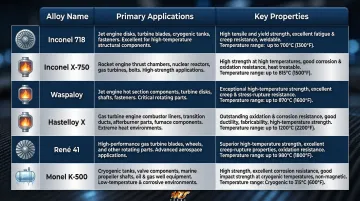
MTS Forge produces custom closed-die forgings in several nickel-based superalloys, including Monel 400, Inconel 600, and Incoloy 800, with demonstrated capability to meet rigorous aerospace specifications such as AMS 5667 (X750) for high-temperature engine components.
Cobalt-Based Superalloys
Cobalt-based superalloys rely on solid-solution strengthening and carbide precipitation (MC, M₂₃C₆, M₇C₃) rather than gamma-prime mechanisms. Their primary advantage lies in hot-corrosion resistance—particularly in environments containing sulfur or salt—and superior resistance to wear and thermal fatigue.
Their high-temperature mechanical strength typically falls below nickel-based alloys, but cobalt superalloys excel where hot corrosion dominates failure mechanisms. Common aerospace applications include:
- HAYNES 188: combustor liners and transition ducts, offering excellent resistance to sulfate deposit hot corrosion
- L-605 (Haynes 25): turbine vanes and nozzle rings, valued for strength retention above 870°C
- Stellite 6B: wear-resistant overlays on turbine blade shrouds and seal faces
Cost limits their use: according to USGS data, cobalt cathode averaged $17.00-$17.20 per pound versus nickel at $7.70-$9.75 per pound. Engineers specify cobalt-based alloys only where their corrosion and wear advantages justify that premium.
Iron-Based Superalloys
Iron-based superalloys offer the most cost-effective solution for moderate high-temperature applications. They don't match the temperature limits of nickel or cobalt alloys, but they deliver practical performance for components outside the most extreme thermal zones.
Key iron-based alloys and their roles:
- A-286: Age-hardenable stainless used in turbine discs, cases, and the Space Shuttle Main Engine nozzle; good strength to 704°C
- Invar 36 (FeNi36): Exceptionally low thermal expansion coefficient, ideal for aerospace composite tooling and precision dies
- Nitronic 60: Superior galling and wear resistance for fasteners, pins, and sliding contact components
For applications where extreme heat is not the primary concern, iron-based alloys deliver the mechanical and dimensional performance engineers need at a fraction of the cost.
Key Properties That Make Superalloys Indispensable in Aerospace
High-Temperature Strength
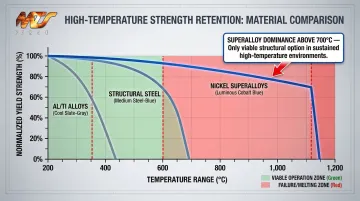
Unlike structural steels that begin losing meaningful strength above 400–600°C, superalloys retain substantial load-bearing capacity well above 700°C. This property enables turbine blades to spin at thousands of RPM in the hottest sections of jet engines without deforming. Inconel 718 maintains excellent creep-rupture strength and high mechanical properties at temperatures up to 700°C, where conventional steels would have already failed.
Creep Resistance
Creep—the slow, permanent deformation of a material under sustained mechanical load at elevated temperatures—is typically the lifetime-limiting factor in turbine blades. In high-pressure turbine (HPT) operation, blades endure extreme centrifugal loads. Analysis of HPT blades operating at 21,772 RPM showed maximum von Mises stresses reaching 2,120 MPa, with approximately 75% of that stress attributable to centrifugal force alone.
Even slight elongation can cause catastrophic blade-tip contact with the engine casing. Single-crystal casting eliminates grain boundaries—the primary sites for creep damage—substantially extending blade service life.
Oxidation and Corrosion Resistance
At high temperatures, superalloys form stable, protective oxide layers that prevent further environmental attack. Two oxide chemistries do most of the work:
- Chromium forms Cr₂O₃, providing solid protection at moderate temperatures
- Aluminum forms Al₂O₃, which holds up at significantly higher temperatures where Cr₂O₃ breaks down
In combustion environments, components face continuous exposure to oxygen-rich, chemically reactive exhaust gases—making both mechanisms essential.
Thermal Barrier Coatings (TBCs) add another layer of defense: an insulating ceramic outer layer (yttria-stabilized zirconia) sits over an inner MCrAlY bond coat that shields the superalloy substrate from oxidation.
Thermal Fatigue Resistance
Aerospace components undergo rapid, repeated temperature cycling—from sub-zero cruising altitudes to combustion temperatures during takeoff and operation. Superalloys' controlled microstructures resist the cracking and crack propagation these thermal expansion mismatches would cause in lesser materials. TBCs and superalloy substrates must withstand these cyclic stresses without spalling or fatigue failure.
Strength-to-Weight Ratio
Every gram of component mass affects fuel efficiency and payload capacity. Superalloys are relatively dense—Inconel 718 weighs 8.19 g/cm³—but their value is measured in specific strength at elevated temperatures. At the temperatures where superalloys operate, titanium and aluminum have already melted or lost structural integrity. In those high-heat zones, superalloys deliver the best available strength-to-weight ratio—because nothing else survives long enough to compete.
Where Superalloys Are Used in Aerospace
Jet Engine Hot Section
The hot section—comprising high-pressure turbine (HPT) blades, vanes, and discs—represents the primary and most demanding application. These components operate closest to the combustion flame, enduring conditions that exceed the limits of nearly every other engineering material.
The Pratt & Whitney F135 engine powering the F-35 operates with turbine inlet temperatures of 3,600°F (1,980°C), while commercial high-performance gas turbines target 1,500–1,600°C to maximize thermodynamic efficiency.
Advanced ceramic matrix composites—used in engines like the GE9X at temperatures approaching 2,400°F (1,315°C)—have reduced some cooling requirements. Even so, nickel-based superalloys remain the only viable option for rotating metallic components in these extreme zones.
Combustion Chambers and Exhaust Nozzles
Combustion liners and exhaust nozzles must withstand not only extreme heat but also mechanical stress from high-velocity gas flow and thermal cycling. Hastelloy X is widely used for combustion zone components—transition ducts, combustor cans, spray bars, and flame holders—due to its exceptional oxidation resistance and ability to maintain ductility after prolonged exposure at 870°C.
Aerospace Structural and Rotating Components
Beyond the hot section, fan blades, compressor discs, shafts, and casings in earlier (cooler) stages rely on superalloys for their strength-to-weight ratio and fatigue resistance. Waspaloy serves extensively in compressor and rotor discs, while landing gear and airframe structural elements use superalloy forgings for high strength and durability.
Military and Defense Aerospace Applications
Military aircraft programs such as the F-22, F-35, and advanced rotorcraft place even higher performance demands on materials. The F-22's Pratt & Whitney F119 features unique thrust-vectoring nozzles, while the F-35 incorporates a Low Observable Axisymmetric Nozzle (LOAN) and thrust-vectoring systems.
Both programs specify superalloys for vector nozzles, thrust chambers, and heat-shield-adjacent components—where component fatigue limits are defined to military tolerances and material substitution is not permitted.
Spacecraft and Rocket Engine Applications
Superalloys face temperatures and pressures in rocket engines that far exceed jet engine conditions. The Space Shuttle Main Engine (RS-25) utilizes Inconel 718 for the main combustion chamber structural shell, which must withstand combustion temperatures reaching 3,300°C. The historical Saturn V F-1 engine used René 41 forgings for the turbine disk and manifold, with Inconel X-750 for rotor blades and stator vanes.
Today's commercial launch vehicles face the same pressure-temperature tradeoffs. SpaceX's Raptor engine operates with cryogenic liquid methane and oxygen at chamber pressures approaching 300 bar, requiring superalloy thrust chambers, exhaust nozzles, and manifolds capable of surviving extreme thermal shock and mechanical stress.
How Superalloys Are Manufactured: Why Forging Matters
Three primary manufacturing methods produce aerospace superalloy components: investment casting, CNC machining from bar stock, and closed-die forging. Each creates different microstructures and therefore different performance outcomes.
Machining Challenges
Nickel-based superalloys like Inconel 718 are notoriously difficult to machine due to rapid work-hardening, high-temperature strength retention, and low thermal conductivity that channels heat into cutting tools. This destroys cutting tools rapidly and adds significant cost when machining complex shapes from solid bar. Advanced solutions include:
- Rigid setups with low cutting speeds
- Coated carbide or PCBN inserts
- Cryogenic cooling using liquid nitrogen
Investment Casting
This method is primary for complex shapes like turbine blades. Directional Solidification (DS) aligns grain boundaries parallel to applied stress, while Single-Crystal (SC) casting eliminates grain boundaries entirely. Eliminating grain boundaries removes the need for grain boundary strengtheners and significantly increases melting temperature and creep resistance.
Closed-Die Forging
Forging refines the coarse, as-cast microstructure into a uniform, fine-grained structure via dynamic recrystallization. This produces denser, more uniform microstructures that enhance mechanical strength, fatigue resistance, and creep resistance compared to cast equivalents.
Closed-die forging also produces near-net shapes, sharply cutting expensive superalloy waste. Traditional machining can have buy-to-fly ratios of 15:1, whereas near-net-shape forging brings this down to 1.1:1 to 3.5:1, saving significant costs on expensive raw materials.
Why MTS Forge for Aerospace and Defense
For aerospace and defense applications, full quality documentation is as non-negotiable as material selection. MTS Forge holds military certifications (Mil I 45208, Mil Q9858) and brings metallurgical expertise to every order.
Key operational advantages include:
- In-house tooling design and development, cutting lead time and tooling cost
- Integrated rough machining that delivers components closer to final specification
- Single-source accountability, eliminating separate vendors and reducing handling risk
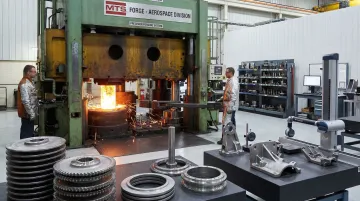
Aerospace procurement requires full documentation of material composition, heat treatment records, and inspection results for every component. MTS Forge's Quality Assurance Program covers the complete production chain — from order entry through forging, heat treatment, and final inspection — providing the traceability defense and aerospace buyers require.
Frequently Asked Questions
What are the superalloys used in aerospace?
The most common aerospace superalloys are primarily nickel-based alloys: Inconel (718, X-750), Waspaloy, René alloys (41), and Hastelloy X. These materials are selected for their exceptional high-temperature strength, creep resistance, and oxidation protection in turbine engines, combustion chambers, and structural components.
Why are superalloys used for spacecraft?
Rocket engine thrust chambers, exhaust nozzles, and manifolds face temperatures exceeding 3,000°C and pressures far beyond atmospheric conditions. Superalloys are the only materials that maintain structural integrity, oxidation resistance, and thermal shock resistance under these extremes — making them essential for reliable space operation.
What is so special about superalloys?
Superalloys combine properties that no conventional metal achieves: simultaneous high mechanical strength, resistance to creep deformation, oxidation protection, and thermal fatigue survival at temperatures where all standard alloys would fail. This combination makes them irreplaceable in aerospace propulsion and defense applications.
What are the three categories of superalloys?
The three categories are nickel-based (most common, offering best high-temperature strength and creep resistance), cobalt-based (superior hot-corrosion and wear resistance in sulfur/salt environments), and iron-based (most cost-effective, suitable for lower-temperature aerospace applications).
What is an example of a superalloy?
Inconel is the most widely recognized superalloy, a nickel-chromium alloy used in jet engine turbine blades, exhaust systems, and rocket engine components. It maintains strength and oxidation resistance at temperatures exceeding 700°C — with Hastelloy X and René 41 serving similar roles in combustion chambers and turbine casings.