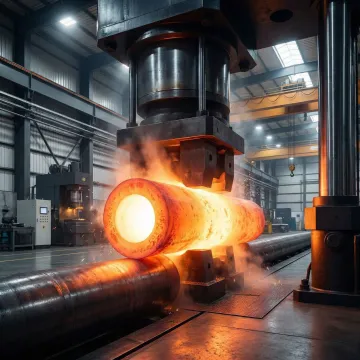
Yes, Inconel can be forged, though it requires specialized equipment and deep metallurgical expertise due to its high work-hardening rate and elevated strength at temperature. Hot forging — typically performed at tightly controlled temperatures between 1800°F and 2200°F depending on the alloy grade — is the standard method. MTS Forge has nearly 40 years of experience forging Inconel and other nickel-based superalloys for aerospace, defense, and power generation applications.
What Inconel grades does MTS Forge work with?
MTS Forge works with a broad range of high-performance alloys, including multiple Inconel grades commonly used in aerospace, defense, and power generation. Specific grade availability depends on the application and geometry. Our team is experienced with nickel-based superalloys that demand precise temperature control and forging pressure management, and we can advise on grade selection based on your mechanical and environmental requirements.
What forging processes are available for Inconel components?
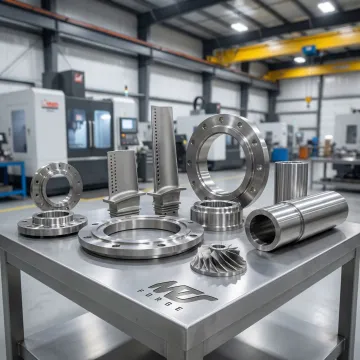
MTS Forge offers closed die forging, upset forging, contour forging, and custom forging for Inconel components. We also produce rings, cylinders, flanges, and manways. Each process is selected based on the component geometry, required mechanical properties, and end-use application. Our adjustable-tonnage press and large tooling inventory give us flexibility across part sizes and configurations.
What is the maximum size or weight for Inconel forgings?
For upset forgings, rings, and cylinders, MTS Forge can produce components up to 26 inches in diameter and up to 1,500 pounds per piece. Flanges are produced up to 14 inches in size. For closed die and custom forgings, capacity depends on the geometry and tooling. Contact our team with your part drawing or specification to confirm feasibility for your specific Inconel component.
Does MTS Forge provide heat treatment for Inconel forgings?
Yes. MTS Forge performs in-house normalizing heat treatment at our Coatesville, PA facility. The normalizing process heats the forged component above its upper critical temperature and allows it to cool in still air, breaking up irregular grain structures created during forging. The result is a refined, uniform microstructure with improved tensile strength, toughness, ductility, and machinability — critical for Inconel components used in high-stress environments.
What quality certifications does MTS Forge hold for Inconel forgings?
MTS Forge operates under a comprehensive Quality Assurance Program certified to Mil I 45208, NCA 3800, and Mil Q9858. These certifications ensure full traceability throughout the production process and are required for customers in aerospace, defense, commercial nuclear, and military sectors. All Inconel forgings are produced with documentation to support downstream inspection, qualification, and regulatory compliance requirements.
Which industries use Inconel forgings from MTS Forge?
MTS Forge supplies Inconel forgings to customers in aerospace, defense, power generation, commercial nuclear, chemical processing, gas and petroleum, and medical manufacturing. Inconel's exceptional oxidation resistance and strength at elevated temperatures make it a preferred alloy for turbine components, pressure vessels, fasteners, flanges, and structural parts operating in extreme thermal or corrosive environments across these sectors.
Does MTS Forge offer rough machining after forging Inconel parts?
Yes. MTS Forge provides in-house rough machining services immediately following the forging process. This involves removing forging flash, surface irregularities, and dimensional excess to bring components close to their near-net shape. Performing rough machining in-house reduces lead times, eliminates the need for a separate machining vendor, and lowers overall handling risk — particularly valuable for Inconel, where third-party machining of superalloys can significantly increase project costs.