Introduction
Commercial aviation recovery, defense modernization programs, and the commercial space build-out are converging in 2026—creating stainless steel demand conditions aerospace procurement teams haven't faced in years. Stainless steel remains a critical structural, fastening, and propulsion material for its corrosion resistance, high-temperature tolerance, and strength: properties that show up in everything from landing gear assemblies to rocket motor casings.
Most aerospace supply chain leaders are contending with the same pressure points right now:
- Securing reliable domestic sources for aerospace-grade stainless steel forgings
- Managing volatile raw material costs without disrupting production schedules
- Staying compliant with shifting trade regulations and domestic content requirements
Understanding where stainless steel demand is heading helps procurement managers, engineers, and manufacturers make sharper sourcing, investment, and production decisions heading into the year.
Key Takeaways
- Global steel demand rebounds to 1,773 Mt in 2026 (+1.3% growth), with aerospace as a high-value driver
- Airbus targeting 870 deliveries, Boeing stabilizing 737 output, and F-35 production ramp-ups create sustained stainless steel consumption
- SpaceX's 301 stainless steel Starship, alongside 263 orbital launches in 2024, confirms stainless steel's role in crewed orbital vehicles
- Section 232 tariffs and DFARS compliance push procurement toward Mil-spec certified, domestically sourced forgings
Key Trend 1: Surging Aircraft Production Ramp-Ups Are Amplifying Stainless Steel Demand
Commercial Aviation Backlog Creates Structural Demand
Resurgent commercial aircraft production is directly expanding stainless steel consumption across the global supply chain. Airbus delivered 793 commercial aircraft in 2025 and targets 870 deliveries in 2026, with plans to reach a production rate of 70 to 75 A320 Family aircraft per month by the end of 2027. Boeing stabilized its 737 production at 38 per month in Q3 2025 and has jointly agreed with the FAA to increase output to 42 per month.
The combined commercial aircraft order backlog exceeds 14,600 units—8,754 for Airbus and over 5,900 for Boeing—locking in multi-year demand for aerospace materials. Procurement teams should plan for sustained materials consumption well through 2027 and beyond.
Where Stainless Steel Remains Essential in Aircraft Systems
Even as carbon fiber composites dominate fuselage share, stainless steel components remain essential for load-bearing and heat-exposed systems:
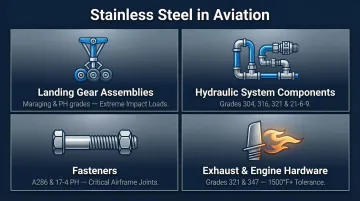
- Landing gear assemblies: High-strength maraging and precipitation-hardened (PH) grades withstand extreme impact loads
- Hydraulic system components: 304, 316, 321, and 21-6-9 stainless tubing provides corrosion resistance in pressurized environments
- Fasteners: A286 and 17-4 PH stainless steel fasteners secure critical airframe joints
- Exhaust-side engine hardware: 321 and 347 stainless alloys tolerate 1500°F+ temperatures in turbine exhaust paths
Each narrow-body aircraft contains hundreds of stainless steel components—and wide-body platforms significantly more. When production rates climb from 38 to 75 aircraft per month, the cumulative stainless steel demand multiplies accordingly.
That demand doesn't stop at commercial aviation. Military procurement programs are driving a parallel surge in high-grade stainless consumption.
Defense Procurement Adds Parallel Demand Layer
Military aircraft programs are amplifying stainless steel consumption alongside commercial aviation. The F-35 program delivered 191 aircraft in 2025, with the USAF alone procuring 24 additional aircraft in FY2026. High-grade stainless steels are critical in:
- Military aircraft engines (combustion chambers, fuel nozzles)
- Fuel system components requiring corrosion resistance and pressure integrity
- Precision structural components in avionics bays and weapons mounts
The Aerospace & Defense Metal Bellows Market, valued at $243.8 million in 2024 and projected to reach $339.8 million by 2034, illustrates demand for precision stainless steel subcomponents across both sectors.
These bellows manage pressure fluctuations and maintain leak-tight sealing in fuel, hydraulic, and environmental control systems. Stainless steel alloys form the material base for virtually all of them.
Key Trend 2: Stainless Steel's Expanding Role in Space Launch Vehicles and Hypersonic Systems
SpaceX Validates Stainless Steel for Next-Generation Launch Vehicles
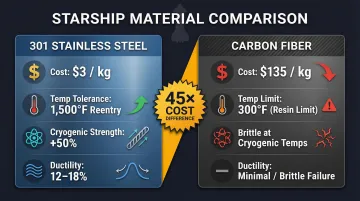
SpaceX's landmark decision to use 301 stainless steel as the primary structural material for the Starship vehicle represents a fundamental validation of stainless steel for reusable space vehicles. Elon Musk explained that at cryogenic temperatures, high chrome-nickel stainless steel's strength increases by 50% without becoming brittle. It maintains 12 to 18 percent ductility — a critical property for liquid methane and oxygen tankage.
Stainless steel also provides a high melting point, allowing it to withstand interface temperatures of 1,500°F during atmospheric reentry, compared to the 300°F limit of carbon fiber resins. The cost difference is stark: stainless steel runs approximately $3 per kilogram, versus $135 per kilogram for carbon fiber.
Record Launch Cadence Drives Volume Consumption
Commercial space launch activity is accelerating rapidly. In 2024, there were a record 263 orbital launch attempts globally, surpassing the previous record of 223 attempts in 2023. SpaceX conducted more than half of these missions, including four near-orbital flight tests of the Starship-Super Heavy system.
This high launch frequency and reusability model creates a new "rapid consumption and replacement" demand pattern for stainless steel components. Traditional aerospace procurement cycles produced parts manufactured once and maintained for decades — that model no longer applies here.
Hypersonic Weapon Programs Require Extreme-Heat Alloys
Hypersonic weapon programs require stainless steel alloys with extreme heat resistance and oxidation resistance. The U.S. Department of Defense requested $3.9 billion for hypersonic research in FY2026, down from $6.9 billion in FY2025, as programs transition from research toward procurement phases. Notably:
- The Air Force's Air-Launched Rapid Response Weapon (ARRW) procurement received $387 million
- The Hypersonic Attack Cruise Missile (HACM) Research, Development, Test & Evaluation (RDT&E) increased to $803 million to continue development through FY2029
These programs demand specialized stainless alloys for airframe skins, combustion chamber liners, and nose cone structures capable of surviving sustained Mach 5+ flight regimes—requirements that distinguish them from standard aerospace applications.
Key Trend 3: Domestic Sourcing Push and the Trade Policy Advantage for US Producers
Stainless Steel Under Section 232 and Trade Protectionism
Ongoing Section 232 tariffs maintain a 25% ad valorem tariff on steel imports from most countries, creating a structural pricing and compliance advantage for domestic aerospace-grade steel manufacturers and forgers. Defense supply chains especially require domestic sourcing under DFARS 252.225-7009, which mandates that specialty metals incorporated into delivered items must be melted or produced in the United States, its outlying areas, or a qualifying country.
Mil-spec certified domestic forgers—such as MTS Forge, which holds Mil I 45208, NCA 3800, and Mil Q9858 certifications—are positioned to capitalize on the reshoring wave in aerospace and defense manufacturing. These certifications satisfy federal procurement requirements and ensure fully traceable, American-made components from first melt to final delivery.
The reshoring trend is quantifiable: U.S. manufacturing reshoring and foreign direct investment resulted in 244,000 announced jobs in 2024, with the Transportation Equipment sector (which includes aerospace) projected to see a 139% increase in reshoring job announcements in 2025.
The Cost Efficiency Argument for Domestic Closed-Die Forging
Beyond tariff compliance, domestic closed-die forging gives aerospace customers measurable cost advantages over machining from bar stock:
- Creates near-net-shape components, cutting material removal and scrap — a direct savings when nickel-driven stainless pricing is volatile
- Produces superior grain flow and mechanical properties, often eliminating secondary operations like heat treatment or surface hardening
- Delivers components closer to final dimension, reducing downstream machining time and labor
- Enables forgers with large tooling inventories to produce shapes rather than machine from bar, helping customers hold schedule when raw material costs spike
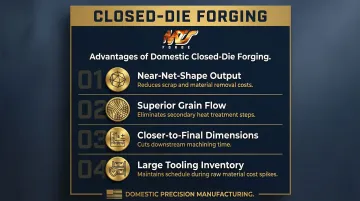
Taken together, these advantages make domestic closed-die forging a supply chain hedge as much as a cost play — particularly for aerospace programs with fixed delivery windows and tight material budgets.
Key Trend 4: High-Performance Stainless Grade Evolution and Alloy Innovation
Precipitation-Hardened Stainless Steels Gain Aerospace Share
The growing adoption of precipitation-hardened (PH) stainless steels—particularly 17-4 PH and 15-5 PH—reflects intensifying performance requirements in aerospace applications. These grades deliver high strength-to-weight ratios alongside corrosion resistance, making them increasingly specified for:
- Engine mounts and actuators requiring 170 ksi yield strength
- Aerospace fasteners in corrosive environments
- Structural fittings on next-generation aircraft where weight savings are critical
According to aerospace material specifications, 17-4 PH (AMS 5643) and 15-5 PH (AMS 5659) both achieve typical yield strengths of 170,000 psi in Condition H900. That strength level, combined with salt-spray-rated corrosion resistance, eliminates the protective coating steps typically required for lower-grade steels in harsh operating environments.
Maraging Steel for High-Stress Applications
Maraging steel remains irreplaceable in ultra-high-stress aerospace components. With nominal yield strengths of 300,000 psi (Maraging C300 per MIL-S-46850), these alloys are specified for:
- Landing gear assemblies
- Rocket motor casings
- High-load structural parts in military aircraft
While composites dominate mass-driven fuselage and wing skin applications, maraging steel's extreme yield strength (up to 350 ksi) and fracture toughness keep it essential for safety-critical, load-bearing components.
Additive Manufacturing Powders vs. Wrought Forms
The aerospace sector is a primary driver for metal additive manufacturing, with shipments of AM systems for metal parts increasing by 24.4% in 2023, reaching an estimated 3,793 systems sold. This hardware growth correlates with increased consumption of specialized stainless steel and titanium metal powders for aerospace prototyping and small-batch component production.
Wrought and forged forms retain dominance for load-critical certified components, for reasons that go beyond material properties:
- Aerospace certification requires extensive mechanical property validation and documented traceability
- Forging qualification pathways carry decades of proven reliability data that AM processes are still building
- Closed-die forgings produce consistent grain flow and density that powdered-metal AM cannot yet fully replicate at scale
For prototype housings and non-structural brackets, AM offers real design flexibility. For certified structural parts, forged and wrought forms remain the qualified standard.
What's Driving These Stainless Steel Trends in Aerospace
Global Steel Demand Recovery Provides Macroeconomic Tailwind
The World Steel Association's October 2025 Short Range Outlook projects global steel demand will reach 1,773 million tonnes in 2026, representing 1.3% growth over 2025. Regional dynamics provide further context:
- EU + UK: Demand forecast to grow 3.2% in 2026, driven by defense and infrastructure spending
- United States: Steel demand expected to grow 1.8% in 2026, aided by private investment
- India: Projected robust growth of 9.1% in 2026, reaching 175.7 Mt
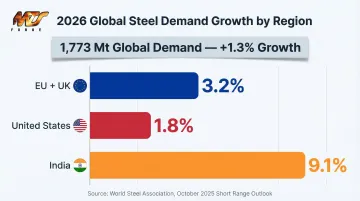
Aerospace stainless steel represents a premium-value segment within this broader market recovery—high-specification alloys commanding price premiums over commodity steel grades.
Technology Advances and Fleet Modernization
Next-generation aircraft programs demand materials with tighter property tolerances and greater performance consistency. The A320neo family, 737 MAX successor platforms, and advanced military jets all require:
- Alloys with narrower chemical composition windows
- Forgings with controlled grain structure and directional properties
- Heat treatments delivering consistent, repeatable mechanical properties
This pushes aerospace manufacturers toward higher-specification stainless grades and tighter manufacturing processes. Closed-die forging, for instance, delivers controlled grain flow and consistent dimensional tolerances that casting or bar machining cannot reliably match.
Geopolitical Instability and Defense Spending
Global security tensions have triggered sustained increases in defense budgets. According to the Stockholm International Peace Research Institute (SIPRI), world military expenditure reached $2,718 billion in 2024, representing a 9.4% increase in real terms from 2023—the steepest year-on-year rise in recent history.
This defense spending directly funds aircraft procurement programs and fleet expansions that consume stainless steel at scale, from fighter jet engine components to missile structural hardware.
Raw Material Cost Dynamics
Nickel—a primary alloying element in austenitic stainless grades—is forecast to average $15,500 per metric ton in 2026 amid global oversupply, down from $21,521 per metric ton in 2023. This price stabilization offers meaningful pricing predictability for aerospace stainless producers after years of volatility.
Chromium has similarly stabilized, giving procurement managers a practical basis to negotiate multi-year fixed-price contracts for austenitic and PH stainless grades.
Supply Chain Security and Domestic Sourcing
Western aerospace OEMs are reducing dependence on single-origin raw materials following supply disruptions during the COVID-19 pandemic and ongoing geopolitical pressures. Current procurement standards increasingly require suppliers to demonstrate:
- Transparent traceability from melt through final component
- Domestic production capabilities
- Certified quality management systems (Mil I 45208, NCA 3800, Mil Q9858)
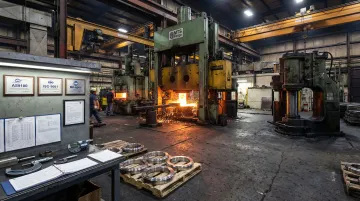
MTS Forge holds all three Mil-spec certifications listed above and manufactures forgings domestically in Coatesville, PA—meeting the traceability and sourcing documentation requirements that defense and aerospace contracts now mandate.
How These Trends Are Impacting the Aerospace Industry
Operational Impact
Aerospace supply chains are extending qualification cycles for new stainless steel grades, requiring forging partners and material suppliers to demonstrate compliance with tighter dimensional and metallurgical tolerances. Lead times for specialty stainless forgings are being managed through:
- Earlier procurement commitment to secure supplier capacity
- Strategic inventory building of long-lead materials
- Dual-source qualification strategies to mitigate single-supplier risk
Procurement managers handling 300-series and precipitation-hardening stainless steels—used in fasteners and hydraulic systems—need long-term agreements in place before production ramp schedules tighten further.
Business Impact
Aerospace OEMs and Tier-1 suppliers are shifting investment priorities toward domestic supply partnerships. This creates new commercial opportunities for certified US-based forging companies with proven aerospace and defense track records.
The tariff environment and DFARS compliance requirements mean procurement teams must rigorously audit suppliers to confirm specialty metals are melted or produced domestically. Forgers that provide full traceability across heat certifications, material test reports, and chain-of-custody documentation are better positioned to win long-term supply agreements.
Key compliance checkpoints for supplier audits include:
- Domestic melt and manufacture verification under DFARS
- Heat certifications and material test reports for each lot
- Unbroken chain-of-custody documentation from raw material to finished forging
Workforce Impact
The shift toward high-performance stainless grades and precision forging processes is increasing demand for workers with metallurgical expertise and quality assurance skills. Specifically, aerospace manufacturers need personnel familiar with:
- Mil-spec standards and aerospace certification requirements
- Advanced non-destructive testing methods
- Heat treatment process control for precipitation-hardening cycles
This workforce development challenge is particularly acute as the industry expands production rates while simultaneously increasing technical complexity.
Future Signals for Stainless Steel in Aerospace Through 2027
The following signals indicate how stainless steel demand will continue evolving. The World Steel Association's regional projections—EU+UK growth of 3.2%, India's sustained 9.1% growth, and US recovery at 1.8% in 2026—provide macroeconomic tailwinds for aerospace-grade steel producers.
Three near-term developments to monitor:
- Hypersonic weapon program procurement ramp-ups: As programs transition from RDT&E to procurement phases, demand for ultra-high-strength stainless grades capable of sustained hypersonic flight will accelerate
- SpaceX Starship commercial deployment pace: The cadence of Starship production and launch operations will set the template for stainless-intensive reusable space vehicle manufacturing across the industry
- Section 232 tariff expansion: Any broadening of trade restrictions could further tilt the competitive playing field toward domestic forging suppliers with established Mil-spec certifications
1–3 Year Scenario
Each of these signals points in the same direction: sustained, structurally high demand for aerospace stainless steel through at least 2027.
Backlog-driven OEM production keeps that floor in place. Combined Airbus and Boeing backlogs exceeding 14,600 aircraft guarantee multi-year consumption regardless of short-term macro fluctuations.
Trade and defense policy reinforce the reshoring case. Manufacturers that establish certified domestic supply chains now—particularly with forgers holding Mil I 45208, NCA 3800, and Mil Q9858 certifications—will carry durable cost and compliance advantages through 2027 and beyond.
With nickel prices stabilizing near $15,500 per metric ton, procurement managers have a practical opening to negotiate long-term material contracts and lock in pricing predictability during this high-demand cycle.
Conclusion
Stainless steel demand in the 2026 aerospace market reflects converging forces: commercial and military aircraft production ramp-ups, commercial space expansion, advanced alloy adoption, and domestic sourcing pressure from Section 232 tariffs and DFARS compliance. These are structural shifts — not temporary fluctuations — and they demand strategic sourcing decisions now.
Airbus targeting 870 deliveries, Boeing stabilizing 737 output at 42 per month, F-35 production continuing, and SpaceX's stainless steel Starship validating new material applications—these are quantifiable demand drivers that will sustain stainless steel consumption through 2027.
Aerospace and defense manufacturers who engage early with Mil-spec certified domestic forging partners will be best positioned to absorb supply chain volatility and meet tightening specification demands. Early engagement also reduces total component cost — a compounding advantage as production rates climb.
MTS Forge brings 40 years of forging experience, Mil-spec certifications (Mil I 45208, Mil Q9858), and proven capabilities in 17-4 PH and 15-5 PH stainless steel forgings. For procurement teams navigating tighter specifications and domestic sourcing mandates, that combination of traceability, metallurgical depth, and Made-in-America production is a measurable advantage.
Frequently Asked Questions
What is the global steel demand forecast for 2026?
The World Steel Association's October 2025 Short Range Outlook projects global steel demand will reach approximately 1,773 million tonnes in 2026, representing 1.3% growth over 2025. This rebound is driven by recovering demand in Europe (+3.2%), the United States (+1.8%), and strong growth in India (+9.1%) and developing economies.
What is the outlook for stainless steel in 2026?
Stainless steel demand in 2026 is expected to hold firm, driven by aircraft production backlogs exceeding 14,600 units, $2,718 billion in global defense modernization spending, and expanding commercial space activity. Nickel averaging $15,500 per metric ton and stabilized chromium pricing offer moderate cost predictability after years of volatility.
What steel products are in high demand in aerospace?
Aerospace applications drive high demand for stainless steel forgings, precision-machined structural components, fasteners, landing gear assemblies, and engine hardware. Particularly sought-after are precipitation-hardened grades like 17-4 PH and 15-5 PH (delivering 170 ksi yield strength), as well as maraging steel for ultra-high-stress applications like rocket motor casings and landing gear.
Why is stainless steel used in aerospace applications?
Aerospace demands materials that hold up under extreme mechanical loads, moisture, heat, and pressure—stainless steel delivers on all four. Its corrosion resistance, high-temperature performance above 1,500°F, fatigue strength under cyclic loading, and machinability make it the material of choice across commercial and military aircraft platforms.
Which stainless steel grades are most commonly used in aerospace manufacturing?
Commonly specified aerospace grades include:
- 17-4 PH / 15-5 PH — high-strength applications per AMS 5643 and AMS 5659
- 301 — structural applications (including SpaceX Starship)
- 304 / 316 — corrosion-resistant hardware and hydraulic tubing
- 321 / 347 — exhaust-side engine hardware
- Maraging steels — landing gear and rocket motor casings
How are US trade policies affecting aerospace stainless steel procurement?
Section 232 tariffs impose a 25% duty on imported steel, while Buy American and DFARS 252.225-7009 rules require defense-contract specialty metals to be domestic or from qualifying countries. This raises the strategic value of US-based forgers holding Mil I 45208, NCA 3800, and Mil Q9858 certifications—suppliers who simplify compliance without adding landed-cost risk.