Introduction
When standard austenitic grades like 304 or 316 fail in chloride-rich or high-stress environments, the failure modes are predictable and costly: pitting corrosion, crevice attack, and stress corrosion cracking. Each one means downtime, safety exposure, and unplanned maintenance.
The question engineers face is how to get more performance without a steep cost or weight penalty.
Duplex stainless steel addresses that directly. This two-phase alloy combines ferritic and austenitic structures, delivering roughly twice the yield strength of standard austenitic grades alongside superior corrosion resistance. Research shows standard duplex accounts for approximately 68% of the total duplex market — a figure that reflects how widely it has been adopted across oil and gas, chemical processing, and power generation.
What follows covers the microstructure, grade classifications, key properties, and real-world applications — with fabrication considerations for specifying the right grade in demanding service conditions.
Key Takeaways
- Duplex stainless steel combines austenite and ferrite phases for twice the strength of 316 with superior corrosion resistance
- Grades range from lean duplex (PREN ~25) to hyper duplex (PREN >50) for increasingly aggressive environments
- Superior resistance to chloride stress corrosion cracking makes duplex ideal for hot water, marine, and chemical applications
- Standard 2205 dominates the market, offering the best balance of performance, availability, and cost
- Requires careful welding and forging practices to maintain phase balance and avoid embrittlement
What Is Duplex Stainless Steel?
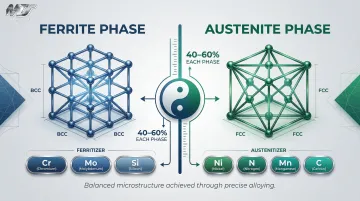
Duplex stainless steel is a family of corrosion-resistant alloys with a two-phase microstructure consisting of approximately equal proportions of austenite (face-centered cubic lattice) and ferrite (body-centered cubic lattice). The "duplex" name refers directly to this dual-phase structure, which gives the material a unique combination of properties that neither phase can deliver alone.
Achieving the Austenite/Ferrite Balance
The balanced microstructure is achieved through precise alloying. Duplex grades typically contain:
- Chromium: 20–28% (higher than most austenitics)
- Molybdenum: Up to 5% (enhances pitting resistance)
- Nickel: Lower than typical austenitics (reduces cost and volatility)
- Nitrogen: Deliberate additions up to 0.60% (critical for austenite formation and corrosion resistance)
Ferritizers (Cr, Mo, Si) promote ferrite formation, while austenitizers (Ni, N, Mn, C) stabilize the austenite phase.
By balancing these elements, steelmakers create a microstructure where each phase occupies approximately 50% of the volume — though acceptable ranges typically span 40–60% for each phase.
Historical Context and Market Position
The first duplex stainless steel was cast in 1930 at Avesta, Sweden, but these early grades suffered from weldability issues. Modern duplex grades only became widely adopted from the 1990s onward, driven by advances in nitrogen control during steelmaking. Nitrogen additions—once difficult to manage—are now precisely controlled using argon-oxygen-decarburization (AOD) and vacuum-oxygen-decarburization (VOD) processes.
That technical progress hasn't translated into broad market dominance — duplex grades still hold a niche share compared to austenitic standards like 304 and 316. For engineers specifying duplex, this matters: suppliers, fabricators, and end-users often have less exposure to its processing requirements, making material knowledge a practical necessity rather than an academic one.
Key Properties of Duplex Stainless Steel
Mechanical Strength
The 0.2% proof strength of duplex grades ranges from approximately 400–550 MPa—roughly twice that of standard austenitic grades like 304 (~280 MPa) or 316 (~290 MPa). This strength advantage allows engineers to specify thinner wall sections in:
- Pressure vessels and storage tanks
- Pipelines and flowlines
- Structural members and supports
Reduced thickness translates directly to lower material weight and cost, often offsetting duplex's higher price per kilogram compared to standard austenitics.
Corrosion Resistance and PREN
The Pitting Resistance Equivalent Number (PREN) is the standard ranking tool for comparing corrosion resistance across stainless steel grades:
PREN = %Cr + 3.3 × %Mo + 16 × %N
Duplex grades span a wide PREN range:
- Lean duplex: PREN ~25–27 (comparable to 316L)
- Standard duplex: PREN ~33–36 (exceeds 316L significantly)
- Super duplex: PREN ~40–43 (comparable to 6% Mo super austenitics)
- Hyper duplex: PREN >50 (for extreme acid and chloride environments)
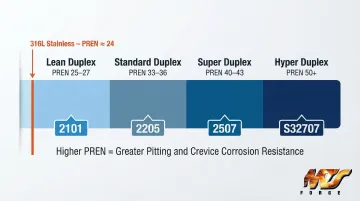
This range allows engineers to match the grade precisely to the corrosive environment, selecting only what the service conditions actually demand.
Stress Corrosion Cracking (SCC) Resistance
Standard austenitic grades like 304 and 316 are particularly vulnerable to chloride-induced SCC under the combination of:
- Tensile stress (residual or applied)
- Chloride environment (even low concentrations)
- Elevated temperature (typically above 50°C)
Duplex steels, like ferritic grades but unlike most austenitics, are highly resistant to SCC. This resistance makes duplex the preferred choice for:
- Hot water systems and heat exchangers
- Brewing and food processing tanks
- Desalination plants
- Swimming pool structures and marine environments
Temperature Limitations
That SCC resistance comes with a trade-off: duplex steels operate within a defined temperature window that engineers must account for at the design stage.
Upper service limit: Approximately 300–315°C
Above this range, two metallurgical phenomena occur:
- 475°C embrittlement: Spinodal decomposition of the ferrite phase into iron-rich and chromium-rich nanophases
- Sigma phase precipitation: Formation of a brittle intermetallic compound that severely reduces toughness and corrosion resistance
Lower service limit: Approximately -50°C to -80°C
Duplex steels exhibit a ductile-to-brittle transition temperature (DBTT) due to the ferrite phase. While acceptable for most oil and gas applications, duplex is unsuitable for cryogenic service such as LNG storage.
Toughness and Weldability
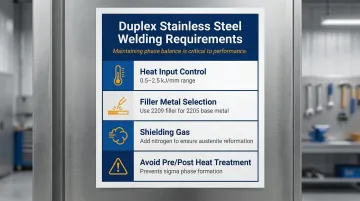
Duplex grades offer significantly better low-temperature toughness and weldability in thick sections than ferritic stainless steels. However, they require more care than austenitics:
- Proper heat input control (typically 0.5–2.5 kJ/mm)
- Use of appropriate filler metal (for example, 2209 filler for 2205 base metal)
- Nitrogen additions to shielding gas (to ensure austenite reformation)
- Avoid pre-heating and post-weld heat treatment, which can promote sigma phase formation
Grades of Duplex Stainless Steel
Lean Duplex (PREN ~22–27)
Lean duplex grades such as 2101 (S32101) and 2304 (S32304) are characterized by low nickel and molybdenum content. Nitrogen and manganese are used to maintain the austenite/ferrite balance, compensating for reduced nickel.
Key characteristics:
- Corrosion resistance broadly comparable to 316L
- High yield strength (450–500 MPa)
- Lower alloy cost due to reduced nickel content
- Suited for structural applications, storage tanks, and construction
Standard Duplex (PREN ~33–36)
2205 (S31803/S32205) is by far the most widely used duplex grade globally. According to the Nickel Institute, 2205 is the "work-horse grade" and "most widely used of all second-generation duplex stainless steels".
Typical composition:
- Chromium: 22%
- Nickel: 5.7%
- Molybdenum: 3.1%
- Nitrogen: 0.17%
Performance:
- Pitting and crevice corrosion resistance comparable to 904L austenitic steel
- Yield strength over twice that of 316
- Used across virtually all industry sectors
The original S31803 specification permitted lower minimums for chromium, molybdenum, and nitrogen — tolerances that could affect weldability and corrosion resistance. S32205 tightened those ranges, restricting composition to the upper half of S31803 limits to guarantee consistently high performance.
Super Duplex (PREN ~38–45)
Grades like 2507 (S32750) and Zeron 100 (S32760) contain approximately:
- Chromium: 25%
- Nickel: 7%
- Molybdenum: 3.5–4%
- Nitrogen: 0.24–0.32%
Performance:
- Corrosion resistance essentially equivalent to 6% Mo super austenitic grades
- Preferred for the most aggressive chloride and chemical environments
- Higher alloy content increases risk of sigma phase formation during processing, requiring careful thermal management
Hyper Duplex (PREN >50)
Hyper duplex grades such as S32707 and S33207 contain:
- Chromium: 26–33%
- Molybdenum: 3.5–5%
- Nitrogen: 0.40–0.60%
These grades target the most extreme acid and chloride environments. Production is currently limited, with seamless tubing as the primary form, serving deepwater oil and gas and specialty chemical applications.
The table below summarizes compositional ranges and PREN values across all four grade families for direct comparison.
Grade Comparison Table
| Grade Family | Common Name | UNS Number | Cr (%) | Ni (%) | Mo (%) | N (%) | PREN |
|---|---|---|---|---|---|---|---|
| Lean | 2101 | S32101 | 21.0–22.0 | 1.35–1.70 | 0.10–0.80 | 0.20–0.25 | 25–27 |
| Lean | 2304 | S32304 | 21.5–24.5 | 3.00–5.50 | 0.05–0.60 | 0.05–0.20 | 25–28 |
| Standard | 2205 (Original) | S31803 | 21.0–23.0 | 4.50–6.50 | 2.50–3.50 | 0.08–0.20 | 31–35 |
| Standard | 2205 (Optimized) | S32205 | 22.0–23.0 | 4.50–6.50 | 3.00–3.50 | 0.14–0.20 | 35–36 |
| Super | 2507 | S32750 | 24.0–26.0 | 6.00–8.00 | 3.00–5.00 | 0.24–0.32 | 40–43 |
| Super | Zeron 100 | S32760 | 24.0–26.0 | 6.00–8.00 | 3.00–4.00 | 0.20–0.30 | 40–43 |
| Hyper | S32707 | S32707 | 26.0–29.0 | 5.50–9.50 | 4.00–5.00 | 0.30–0.50 | 49–50 |
Data sourced from ISSF Duplex Stainless Steels (2021) and Nickel Institute Practical Guide (2020)
Duplex Stainless Steel vs. Other Grades
Duplex vs. 316L Austenitic
316L is often the default upgrade from 304, but duplex grades offer a meaningful step up:
Advantages of duplex over 316L:
- More than twice the yield strength (450 MPa vs. 290 MPa)
- Significantly better SCC resistance in chloride environments
- Comparable or superior pitting resistance (2205 PREN ~35 vs. 316L PREN ~24)
- Similar or sometimes lower price due to reduced nickel content
When 316L remains preferable:
- Applications requiring high formability or cold heading
- Cryogenic service below -80°C
- When fabricators lack duplex welding expertise
Duplex vs. 304 Austenitic
304 should be considered only for mild, non-chloride environments with low stress. In any application where 304 is failing due to SCC, pitting, or insufficient strength, lean or standard duplex grades are the logical next step.
Key benefits:
- Higher yield strength, better PREN scores, and superior SCC resistance across the board
- Better price stability (duplex contains less nickel, whose price is highly volatile)
- Reduced lifecycle costs through longer service life
Duplex vs. Ferritic Stainless Steels
Ferritic grades share duplex's SCC resistance, but that's where the similarity ends. Ferritics suffer from:
- Poor weldability in thick sections
- Poor low-temperature toughness
- Lower strength than duplex grades
Duplex largely overcomes these limitations while maintaining the SCC resistance advantage.
Cost and Lifecycle Considerations
The total cost of ownership argument for duplex centers on material efficiency. Higher yield strength allows thinner wall sections in pressure vessels and tanks, which can offset the higher initial material cost.
A pressure vessel designed with 2205 instead of 316L, for example, might use 40% less material by weight while delivering superior corrosion performance. The downstream savings add up quickly:
- Lower material costs
- Reduced transportation weight
- Easier on-site installation
Industrial Applications of Duplex Stainless Steel
Duplex stainless steel's combination of high strength, corrosion resistance, and stress cracking tolerance makes it a go-to material across several demanding industries. Below are the sectors where it sees the heaviest use.
Oil, Gas, and Energy
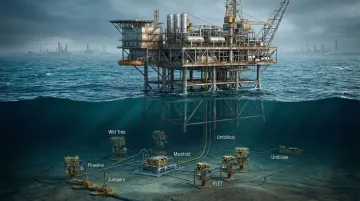
Subsea and topside environments expose equipment to chloride-rich seawater, hydrogen sulfide, and high-pressure fluctuations — conditions that push carbon steel and standard austenitic grades to their limits. Duplex grades like 2205 and 2507 handle these environments reliably.
Common oil and gas applications include:
- Flowlines, manifolds, and subsea risers
- Pipelines for sour gas and corrosive crude transport
- Heat exchangers and high-pressure vessels
- Pumps, valves, and compressor components
Chemical Processing
Chemical plants deal with aggressive acids, chlorides, and process fluids at elevated temperatures. Duplex stainless steel resists pitting and crevice corrosion better than 316L, which reduces maintenance downtime and extends equipment service life.
Typical chemical processing uses include:
- Reactor vessels and storage tanks
- Piping systems for acids and chloride-containing streams
- Agitators and mixing equipment
- Scrubbers and heat exchanger tubing
Power Generation and Nuclear
Power generation infrastructure — including commercial nuclear facilities — demands materials that maintain structural integrity under thermal cycling, high-pressure steam, and radiation exposure. Duplex grades meet strict standards for these applications, aligning with certifications such as NCA 3800 used in nuclear-related manufacturing.
Key applications in this sector include:
- Feedwater heaters and condenser tubing
- Pressure vessels and steam generator components
- Pump housings and valve bodies for nuclear service
- Structural components in offshore and onshore power infrastructure