Introduction
A procurement engineer in the aerospace division receives specifications for a new landing gear component. The part must withstand 40,000 cycles of extreme loading, weigh no more than 250 pounds, and deliver consistent mechanical properties throughout its 8-inch cross-section. The question on the table: should this part be cast, machined from bar stock, or forged from alloy steel?
This choice carries significant consequences. Cast parts may harbor internal porosity that becomes a failure point under cyclic load. Machined parts waste expensive alloy steel as chips and sever the grain structure that naturally resists fatigue. Forged alloy steel components align internal grain flow with stress paths, eliminate voids, and develop uniform mechanical properties throughout the cross-section — advantages that matter in safety-critical applications where failure is not an option.
This guide covers everything needed to specify forged alloy steel: alloying elements and their effects, how forging creates superior microstructure, common grades, and the heat treatment processes that develop final mechanical properties.
Key Takeaways
- Forged alloy steel is shaped under heat and compressive force, producing denser, stronger parts than cast or machined alternatives
- Alloying elements (chromium, nickel, molybdenum, vanadium) improve hardenability, toughness, and corrosion resistance beyond plain carbon steel capabilities
- Forging refines grain structure, eliminates voids, and aligns grain flow parallel to stress directions
- Common grades include 4140 (chromoly) and 4340 (nickel-chromoly) for aerospace, defense, and power generation
- Heat treatment after forging is essential to develop final mechanical properties
What Is Forged Alloy Steel?
Alloy steel is carbon steel to which one or more alloying elements have been intentionally added beyond the levels found in plain carbon steel. These additions — typically chromium, nickel, molybdenum, vanadium, manganese, silicon, or boron — modify the steel's microstructure and deliver properties plain carbon steel can't achieve.
Forging is a manufacturing process in which a steel billet is heated above its recrystallization temperature (typically 1,050–1,250°C for alloy steels) and then shaped using compressive force from a hammer or press. Unlike casting, which solidifies molten metal in a mold, or machining, which cuts material away, forging is the plastic deformation of solid metal under controlled heat and pressure.
What sets forged alloy steel apart is the synergy between chemistry and process. Forging refines microstructure by breaking up chemical segregation, closing porosity, and aligning grain flow. The alloying elements provide enhanced hardenability, ensuring that these refined properties penetrate throughout the full cross-section of large or complex parts — not just at the surface.
Key differences from alternatives:
- Cast alloy steel retains as-cast grain structure with potential porosity and shrinkage voids
- Machined bar stock severs grain flow lines and wastes expensive alloy material as chips
- Forged alloy steel preserves continuous, directional grain flow aligned to the component shape, giving superior fatigue and impact resistance
Chemistry reinforces these structural advantages. Most alloy steel forgings contain 0.20–0.55% carbon. This range is high enough to develop significant strength after quench-and-temper heat treatment, but not so high that the steel becomes difficult to forge or prone to cracking during hot working.
Key Alloying Elements and Their Roles
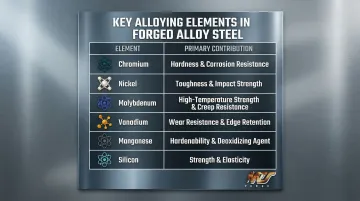
Common alloying elements in forged alloy steels contribute specific properties:
| Element | Primary Contribution |
|---|---|
| Chromium | Hardenability, wear resistance, mild corrosion resistance |
| Nickel | Toughness, low-temperature impact strength |
| Molybdenum | High-temperature strength, resistance to temper embrittlement |
| Vanadium | Grain refinement, fatigue resistance |
| Manganese | Hardenability, deoxidation during steelmaking |
| Silicon | Strength, oxidation resistance |
Hardenability in Large Sections
Hardenability refers to the depth to which steel can be hardened during quenching. Plain carbon steels harden only at or near the surface in large sections. Alloying elements allow hardening to penetrate through the full cross-section — critical for large structural forgings in aerospace, defense, and power generation where uniform mechanical properties are required from surface to core.
Micro-Alloying for As-Forged Properties
Where full-section hardenability demands a complete heat treatment cycle, micro-alloying offers a leaner alternative. Small additions (0.05–0.1%) of vanadium or niobium allow some alloy steel forgings to achieve acceptable mechanical properties in the as-forged condition — no quench-and-temper required. This cuts heat treatment cost and works economically in high-volume applications such as automotive crankshafts.
The Forging Process: How Alloy Steel Gets Its Strength
Starting Material
Alloy steel forgings begin as billets or blooms (continuously cast or rolled from ingot, then cut to a specified weight). Billet quality directly affects forging outcome: internal soundness, chemical uniformity, and freedom from surface defects are all essential. Forging-quality alloy steel is produced to close chemical composition tolerances.
Heating Stage
The billet is heated to the hot working temperature range appropriate for its alloy composition — generally 1,050–1,250°C for alloy steels. Too low and the steel resists deformation; too high and excessive grain growth or incipient melting can degrade properties.
What Happens During Deformation
Compressive force reshapes the internal structure in several ways:
- Breaks up internal porosity and heals shrinkage voids
- Refines the as-cast grain structure
- Causes grains to elongate in the direction of metal flow, creating grain flow lines analogous to wood grain
When grain flow is oriented parallel to the primary service load, fatigue resistance and impact toughness improve measurably compared to a machined or cast equivalent.
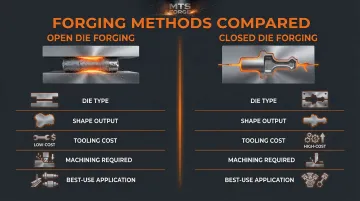
Open Die vs. Closed Die Forging
The two primary forging methods serve different production needs:
| Open Die | Closed Die | |
|---|---|---|
| Die Type | Flat or simple dies | Impression dies matched to part geometry |
| Shape Output | Simple or large shapes | Near-net shapes |
| Tooling Cost | No dedicated tooling | Custom tooling required |
| Machining Required | Substantial finish machining | Minimal — 1.25–2.5 mm allowances typical |
| Best For | Low-volume or very large parts | Repeatable, complex geometries |
Closed-die forging can achieve tolerances as tight as ±0.10 mm on specific features such as gear teeth, with draft angles of 3–7°.
MTS Forge maintains a large tooling inventory to forge net-shape parts rather than machine them from bar — reducing material cost and preserving grain flow in the finished part. Press tonnage is adjustable, which allows use of less expensive die material and keeps custom tooling costs in check.
Post-Forging Operations
After forging, parts undergo trimming of flash (in closed die), surface cleaning (grit blasting to remove scale), rough machining, and heat treatment. The final mechanical properties of alloy steel forgings are largely set during heat treatment — forging creates the structural foundation, but heat treatment activates the full capability of the alloy chemistry.
Mechanical Properties and Advantages Over Cast or Machined Steel
Strength and Toughness
Forging improves ductility and impact strength over cast or as-rolled material by eliminating porosity and breaking up segregation. A case study of 8620 alloy steel gears demonstrated that near-net forging achieved finish grinding allowances of just 0.1–2 mm, bypassing expensive hobbing operations. The continuous grain flow in forged teeth greatly reduced residual stresses, resulting in substantially higher gear life.
Grain Flow and Fatigue Resistance
Forging aligns grain flow to the shape of the part. When grain flow lines are cut — as in machining — stress concentrators arise. Parts designed with forging in mind, where grain flow is parallel to the direction of maximum applied stress, show longer fatigue life under cyclic loading.
This advantage is especially significant for components such as:
- Crankshafts and connecting rods
- Landing gear structures
- Pressure vessel fittings
- Other parts subject to repeated stress cycles
Hardenability and Through-Section Uniformity
Alloying elements allow alloy steel forgings to develop consistent mechanical properties from surface to core, even in large cross-sections. Contrast this with plain carbon steel forgings, which may be hard at the surface but much softer at the core in heavy sections after heat treatment.
Corrosion and Rust Resistance
Forged alloy steels with chromium content (e.g., 4140, 4340) offer better corrosion resistance than plain carbon forgings, but are not inherently rust-proof. Only stainless grades (with ≥11% chromium) resist rust. Standard alloy steel forgings should be protected with coatings, platings, or kept in controlled environments to prevent surface oxidation.
Common Grades and Industry Applications
Widely Used Forged Alloy Steel Grades
4140 (Chromium-Molybdenum)
The workhorse grade. Good balance of strength, toughness, machinability, and fatigue resistance. Used in gears, axles, tooling, and structural components. Typical properties after quench-and-temper: tensile strength 850–1,000 MPa, yield strength 650–850 MPa.
4340 (Nickel-Chromium-Molybdenum)
Higher hardenability and toughness for large cross-sections. Used in aerospace structural components, landing gear, and high-performance shafts. Typical properties after quench-and-temper: tensile strength 1,100–1,300 MPa, yield strength 900–1,100 MPa. MTS Forge supplies 4340 in multiple specifications including AMS 6415 (standard aerospace), AMS 6414 (vacuum melt), and MIL-S-5000 (aircraft quality).
8620 (Nickel-Chromium-Molybdenum)
Commonly carburized for case-hardened components. Used for gears, pinions, and shafts requiring hard wear surfaces with tough cores.
300M (AMS 6419)
A high-strength low-alloy steel used in demanding aerospace applications — particularly landing gear and primary structural components where 4340 does not provide sufficient strength at large section sizes.
Applications by Industry
Aerospace and Defense:
4340 and 300M for landing gear, structural forgings, and munition bodies. MTS Forge holds military certifications Mil I 45208, NCA 3800, and Mil Q9858, meeting the quality standards required in these sectors.
Power Generation:
4140 or alloy grades for turbine components, valve bodies, and pressure-retaining parts.
Automotive and Heavy Equipment:
4140 for crankshafts, connecting rods, and axle shafts.
Oil & Gas and Construction:
Alloy steel for drill collars, flanges, and heavy load-bearing components.
Grade Selection Criteria
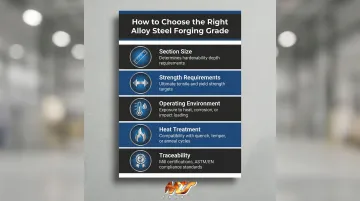
Choosing the right grade comes down to several factors:
- Section size: Larger cross-sections require higher hardenability grades like 4340 or 300M
- Strength requirements: Target tensile and yield values narrow the field quickly
- Operating environment: Temperature extremes and corrosion exposure may drive alloy additions
- Heat treatment: Planned quench-and-temper cycles affect final property outcomes
- Traceability: Safety-critical applications require full material certifications and documented heat numbers
Heat Treatment for Alloy Steel Forgings
Alloy steel forgings are supplied in four main heat treatment conditions:
1. As-Forged
No subsequent thermal processing. Acceptable only for lower carbon or lower criticality parts where machinability is the primary goal.
2. Annealed or Normalized
Softens the steel for machining, refines grain size, and relieves forging stresses. Normalizing involves heating to the austenitizing temperature and air cooling.
3. Quenched and Tempered (Q&T)
The most common condition for structural alloy steel forgings. The process involves austenitizing, rapid quench (oil or water), followed by tempering to achieve the required strength-toughness balance.
4. Normalized and Tempered
Used where Q&T is not feasible but improved properties over annealed condition are needed.
Why Grain Refinement Matters
During austenitizing, prior austenite grain size directly affects final toughness and fatigue resistance. Normalizing before final austenitizing (called a double treatment) is standard practice for high-strength alloy steel forgings with variable section thickness. This produces uniform grain size and minimizes residual stress before quenching, leading to better through-section property uniformity.
These process outcomes are why compliance bodies set precise requirements for them. IACS (International Association of Classification Societies) standards, for example, mandate specific heat treatment protocols for machinery-grade alloy steel forgings — defining minimum grain refinement and mechanical property levels that forgings must meet before entering service.
Frequently Asked Questions
What is forged alloy steel?
Forged alloy steel is alloy steel (carbon steel with intentional additions of elements like chromium, nickel, and molybdenum) that has been shaped under heat and compressive force. This produces a refined grain structure and superior mechanical properties compared to cast or machined alternatives.
Is alloy steel good for forging?
Yes. Alloy steel is among the best materials for forging. Its alloying elements improve hardenability, ensuring the refined grain structure created during forging is retained through heat treatment and delivers uniform strength and toughness across the full part cross-section.
What is drop forged alloy steel?
Drop forging is a closed-die process where a hammer strikes a heated alloy steel billet in a shaped die, forcing metal to fill the cavity completely. The result is excellent grain flow — drop forged alloy steel parts are widely used in high-strength tools, automotive components, and industrial hardware.
What alloy is forged steel?
"Forged steel" can refer to any steel that has been forged, but the most common alloy steels used in forging include 4140 (chromium-molybdenum), 4340 (nickel-chromium-molybdenum), and 8620 (nickel-chromium-molybdenum) — selected based on required strength, section size, and application environment.
Is 4140 steel good for forging?
Yes. 4140 chromium-molybdenum steel is one of the most widely forged alloy grades, valued for its balance of strength, toughness, and machinability. It responds well to quench-and-temper heat treatment, making it a go-to choice for gears, axles, shafts, and structural components.
Does forged alloy steel rust?
Most standard alloy steel forgings (including 4140 and 4340) are not stainless and will rust if exposed to moisture without protection. Coatings, plating, or controlled storage are required. Only alloy steels with sufficient chromium content (≥11%) qualify as stainless and offer inherent rust resistance.