What is the typical lead time for rolled ring production?
Lead times for rolled ring production at MTS Forge vary based on material availability, part complexity, and order volume. However, our vertically integrated facility — with in-house forging, heat treatment, and rough machining — significantly compresses lead times compared to multi-vendor supply chains. Contact us with your specifications for a project-specific timeline and scheduling discussion.
What are the size limitations for rolled rings?
MTS Forge produces upset forgings, rings, and cylinders up to 26 inches in forging diameter and a maximum weight of 1,500 pounds per piece. These size parameters cover a wide range of industrial, aerospace, and power generation ring applications. If your part approaches these limits, our team can advise on the optimal forging method and configuration for your geometry.
What is seamless rolled ring forging?
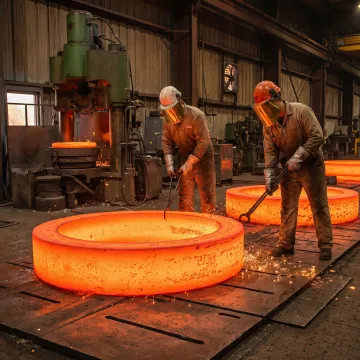
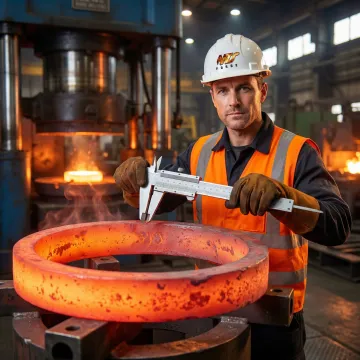
Seamless rolled ring forging is a process where a pre-formed donut-shaped billet is hot-worked between rotating rolls to expand its diameter and reduce wall thickness, producing a ring without a weld seam. The result is a ring with continuous grain flow, superior mechanical properties, and excellent structural integrity — critical for aerospace, pressure vessel, and power generation applications.
How are ring forgings made?
Ring forgings begin with a billet that is cut to precise weight, heated to forging temperature, and pierced or upset to form a donut shape. The preform is then forged — either through ring rolling to expand diameter or through press forging in dies — followed by heat treatment to refine grain structure and machining to achieve near-net dimensional tolerances per customer specification.
What materials are available for forged and rolled rings?
MTS Forge works with nearly all grades available in the market, including carbon steels, alloy steels, stainless steels (including 316-L and duplex grades like Ferralium 255), and high-performance alloys such as Monel K-500. Our metallurgical team can guide material selection based on your application's mechanical, corrosion, and temperature requirements.
Do forged rings require heat treatment after forging?
Yes, heat treatment is strongly recommended — and often required — for forged rings. The forging process creates uneven grain growth and internal stresses. MTS Forge performs in-house normalizing heat treatment at our Coatesville, PA facility, heating components above their upper critical temperature and air-cooling to produce a refined, uniform microstructure with improved tensile strength, toughness, and machinability.
What industries do you supply forged rings to?
MTS Forge supplies forged rings and cylinders to aerospace, defense, commercial nuclear, power generation, chemical processing, machine manufacturing, agriculture, medical, construction, and gas and petroleum industries. Our certified Quality Assurance Program — meeting Mil I 45208, NCA 3800, and Mil Q9858 standards — satisfies the traceability and documentation requirements of these demanding sectors.
Can MTS Forge produce rings to custom specifications?
Absolutely. Custom ring forgings are a core MTS Forge capability. Our team works directly from customer drawings and specifications to produce rings in the required material, dimensional envelope, and tolerance class. With a large in-house tooling inventory and the ability to design and develop new tooling, we can produce custom ring geometries cost-effectively without requiring expensive bar stock machining.