What is the standard for aerospace heat treatment?
Aerospace heat treatment is governed by standards such as AMS 2750 (pyrometry), AMS 2801 (titanium), AMS 2759 (steel), and customer-specific specifications. MTS Forge operates under certifications including Mil I 45208 and NCA 3800, ensuring heat treatment processes meet the traceability, documentation, and mechanical property requirements mandated by aerospace and defense procurement programs.
What is the process of heat treatment in the aerospace industry?
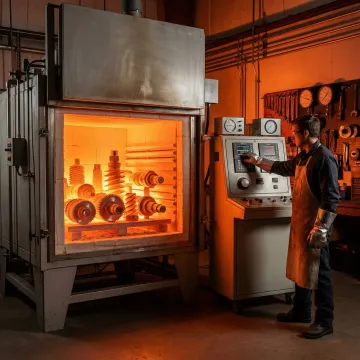
Aerospace heat treatment typically involves heating a forged component to a precise target temperature above its critical transformation point, holding it there for a defined soak time, and then cooling it in a controlled manner—either in still air, a furnace, or quench media. MTS Forge specializes in normalizing, which air-cools parts to refine grain structure and relieve internal stresses introduced during the forging process, improving tensile strength and ductility.
What types of materials does MTS Forge heat treat for aerospace applications?
MTS Forge applies normalizing heat treatment across a broad range of materials including alloy steels, stainless steels such as 316-L, high-performance alloys like Monel K-500, and duplex stainless steels such as Ferralium 255. These materials are used across aerospace, defense, nuclear, and power generation applications where microstructural consistency is mandatory.
Is heat treatment performed in-house at MTS Forge?
Yes. MTS Forge performs normalizing heat treatment entirely in-house at its Coatesville, PA facility. This in-house capability eliminates the need to outsource thermal processing, reducing lead times, minimizing component handling risk, and maintaining full quality control and traceability from forging through heat treatment and into rough machining.
What certifications does MTS Forge hold relevant to aerospace heat treating?
MTS Forge holds certifications including Mil I 45208, NCA 3800, and Mil Q9858. These certifications establish rigorous quality assurance frameworks with complete traceability throughout production, meeting the requirements of aerospace, defense, and commercial nuclear customers who demand documented compliance with military and industry specifications.
Why is normalizing the most common heat treatment specified for hot forgings?
The forging process inherently creates uneven grain growth and internal residual stresses within a component. Normalizing addresses this by heating the part above its upper critical temperature and then air cooling it, which breaks up irregular grain structures and produces a refined, uniform microstructure. This results in more predictable and consistent mechanical properties—critical for aerospace structural components.
Can MTS Forge provide full traceability documentation for heat-treated aerospace components?
Yes. MTS Forge maintains a comprehensive Quality Assurance Program that provides complete traceability throughout the production process—from raw material receipt through forging, heat treatment, and machining. This includes material certifications, process records, and heat treatment logs, satisfying the documentation requirements of aerospace, defense, and nuclear procurement programs.
What industries does MTS Forge serve with its heat treating and forging capabilities?
MTS Forge serves aerospace, defense, commercial nuclear, power generation, chemical processing, machine manufacturing, medical, and construction industries. Its primary customer base includes manufacturers and procurement teams based in Pennsylvania, Iowa, Kentucky, and Texas, with the Coatesville, PA facility acting as the production hub for all forging and heat treatment operations.