What are forged flanges used for?
Forged flanges are used to connect pipes, valves, pumps, and other equipment in pressurized piping systems. They are critical in industries such as oil and gas, power generation, commercial nuclear, chemical processing, and defense, where leak-proof, high-strength connections are required. Their forged construction provides superior pressure resistance compared to alternative joining methods.
What is the difference between forged flanges and plate flanges?
Forged flanges are manufactured from solid steel billets shaped under high pressure, resulting in a refined, directional grain structure that offers superior tensile strength, fatigue resistance, and pressure ratings. Plate flanges are cut from flat rolled plate, which lacks this grain alignment. For critical applications—especially nuclear and power generation—forged flanges are the preferred choice due to their mechanical superiority and reliability.
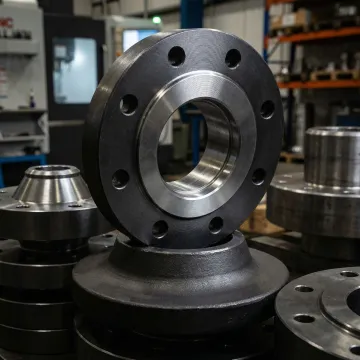
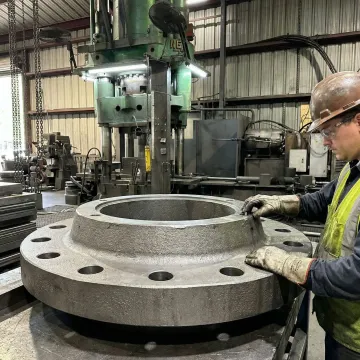
A forged flange is a disc-shaped mechanical component produced by shaping heated steel under compressive force using dies and presses. The forging process aligns the metal's grain structure for enhanced strength and durability. Forged flanges are then machined to precise dimensions and used to join piping system segments with bolted connections, enabling easy assembly, disassembly, and inspection.
What is a forged pipe fitting?
A forged pipe fitting is any pipe connection component—such as an elbow, tee, coupling, or flange—produced through the forging process rather than casting or fabrication from plate. Forged fittings are denser and mechanically stronger than cast alternatives. They are specified in high-pressure, high-temperature, and safety-critical piping systems across nuclear, defense, aerospace, and petrochemical applications.
What is the ASME Code for forged fittings?
The primary ASME code governing forged fittings is ASME B16.11, which covers socket-welding and threaded forged fittings including pressure-temperature ratings, dimensions, tolerances, and marking requirements. For forged flanges, ASME B16.5 and B16.47 apply. In nuclear applications, ASME Section III (NCA 3800) governs quality assurance requirements—a standard that MTS Forge is fully compliant with.
What is the difference between cast and forged pipe fittings?
Cast fittings are made by pouring molten metal into a mold, which can result in internal porosity, voids, and an isotropic grain structure with lower mechanical strength. Forged fittings are shaped under pressure while the metal is solid, producing a denser part with aligned grain flow and no internal defects. Forged fittings consistently outperform cast fittings in tensile strength, impact resistance, and fatigue life—making them the standard for critical service applications.
What materials are available for carbon steel forged flanges?
MTS Forge produces carbon steel forged flanges in a range of alloy and carbon steel grades to suit different pressure, temperature, and corrosion requirements. Beyond carbon steel, we also work with stainless steels, high-performance alloys such as Monel K-500, duplex stainless steels like Ferralium 255, and 316-L stainless steel for Section III nuclear applications. Contact our team to confirm material availability for your specification.
What quality certifications does MTS Forge hold for flange production?
MTS Forge operates under a comprehensive Quality Assurance Program that includes certifications for Mil I 45208, NCA 3800, and Mil Q9858. These certifications govern inspection, quality management, and nuclear-grade manufacturing requirements, ensuring complete traceability from raw material through finished flange. This positions MTS Forge to supply flanges for commercial nuclear, defense, and other safety-critical sectors with confidence.