Introduction
When a component must meet tight tolerances, survive extreme loads, or be produced at scale, the choice between hot and cold forming directly affects structural integrity, material cost, and production efficiency. For engineers and procurement managers in aerospace, defense, and power generation, this decision is highly consequential—selecting the wrong process can result in material failures, cost overruns, or manufacturing delays that cascade through entire programs.
Both processes shape metal through compressive force, but they differ fundamentally in temperature, material behavior, and the parts they can produce. Hot forming heats metal above its recrystallization temperature, transforming it into a plastic, ductile state suited for complex three-dimensional geometries. Cold forming shapes metal at or near room temperature, using work hardening to produce high-strength parts with tight dimensional accuracy.
Which process you choose determines whether a component performs as designed—or fails under load.
This article covers process definitions, mechanics, key differences, and a practical decision guide so manufacturers can select the right forming method for their application.
Key Takeaways
- Hot forming heats metal above its recrystallization temperature, enabling complex shapes and refined grain structure—at the cost of tighter tolerances and higher energy use
- Cold forming produces tight-tolerance, high-strength parts with excellent surface finish, though it's limited to simpler geometries and ductile materials
- Aerospace, defense, and power generation rely on hot forming for complex geometries, refined grain structure, and greater ductility
- High-volume runs of standardized parts favor cold forming, where dimensional accuracy and lower per-unit cost matter most
- Choosing between them comes down to your material, part geometry, mechanical property targets, and production volume—the specifics decide it
Hot Forming vs. Cold Forming: Quick Comparison
Temperature Range
Hot Forming: Metal is heated above its recrystallization temperature—steel reaches approximately 1,150°C (2,100°F), while aluminum requires 400–500°C. This keeps the material in a plastic, highly ductile state throughout the forming process, enabling significant deformation without cracking.
Cold Forming: Performed at or near room temperature without pre-heating. Friction during the process can raise metal temperature to approximately 130°C, but the material never enters the recrystallization zone.
Material Compatibility
Hot Forming: Suited for metals with low room-temperature ductility—high-strength steel alloys, titanium (Ti-6Al-4V), Inconel superalloys, and stainless steel grades that would crack under cold forming pressures. These materials require elevated temperatures to achieve the plasticity necessary for deformation.
Cold Forming: Works best with high-ductility, low-strain-hardening metals: mild steel, aluminum alloys, copper, and low-carbon steel (typically below 0.5% carbon content). Higher carbon steels risk cracking when cold formed.
Dimensional Tolerances
Hot Forming: Less precise due to thermal expansion during forming and contraction during cooling. Parts often require post-machining to reach final dimensions, though closed die hot forging reduces this requirement through near-net-shape production — a capability MTS Forge applies across its custom forging work.
Cold Forming: Produces tighter dimensional tolerances and superior surface finish, often requiring minimal or no finishing work. For applications where tolerances are measured in thousandths of an inch, cold forming is typically the more reliable path.
Part Complexity
Hot Forming: Allows complex, three-dimensional geometries including deep recesses, sharp contours, and intricate custom shapes. The material's plastic state allows undercuts, sharp contours, and deep cavities that would cause cracking at room temperature.
Cold Forming: Best suited for simpler, standardized shapes. Highly complex or custom 3D geometries are difficult to achieve reliably due to material flow limitations at room temperature.
Cost Profile
Hot Forming: Higher upfront energy and tooling costs due to heating requirements. More cost-effective for complex, custom, or lower-volume specialty parts where the alternative would be extensive machining from bar stock.
Cold Forming: Lower per-unit cost at high volumes. No heating equipment needed, and minimal finishing reduces overall production cost. Cold forming can result in savings of 50 to 100 percent compared to traditional machining, with material savings of 30% to 50% compared to hot forging.
What is Hot Forming?
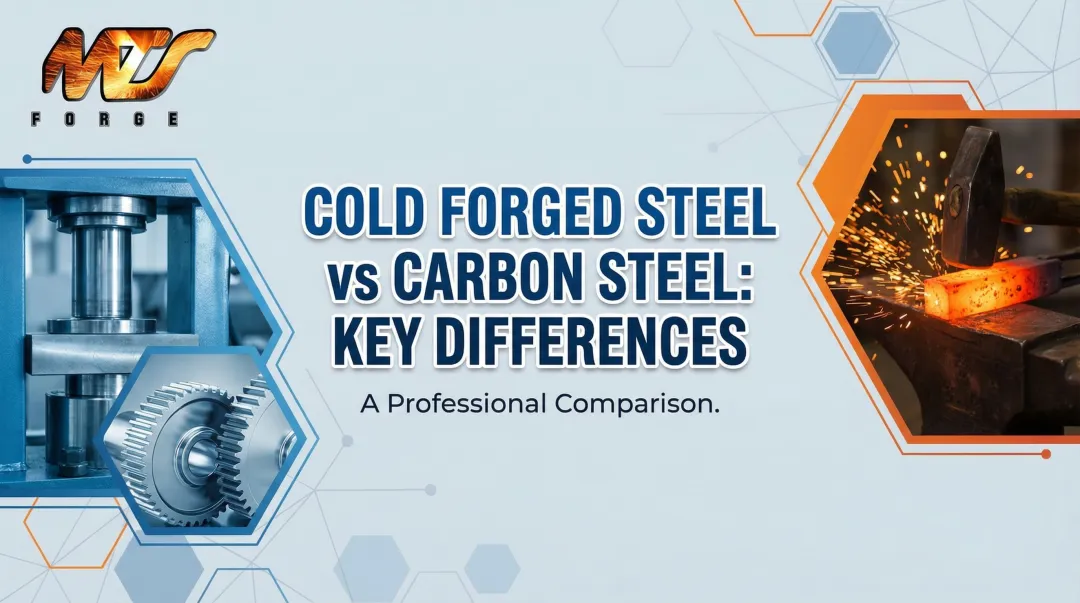
Hot forming is a metal shaping process where the workpiece is heated above its recrystallization temperature before being deformed under pressure using dies, hammers, or presses. At this temperature, the metal enters a plastic-like state that allows significant deformation without cracking or strain hardening—a critical advantage when working with materials that are brittle or difficult to form at room temperature.
Metallurgical Impact and Grain Structure
The heating process triggers grain refinement and recrystallization during forming, which results in a stronger, more ductile grain structure in the finished part compared to as-cast or bar stock starting material. This is why hot-forged parts often outperform machined or cast equivalents in fatigue resistance—the grain flow follows the part's contours rather than being randomly oriented or interrupted by machining operations.
For aluminum, dynamic recrystallization (DRX) occurs at temperatures ranging from 375°C to 600°C depending on purity. For Ti-6Al-4V titanium alloy, optimal hot working requires deformation temperatures above 950°C to achieve proper recrystallization and mechanical properties.
Process Variations
Two primary hot forming methods serve different applications:
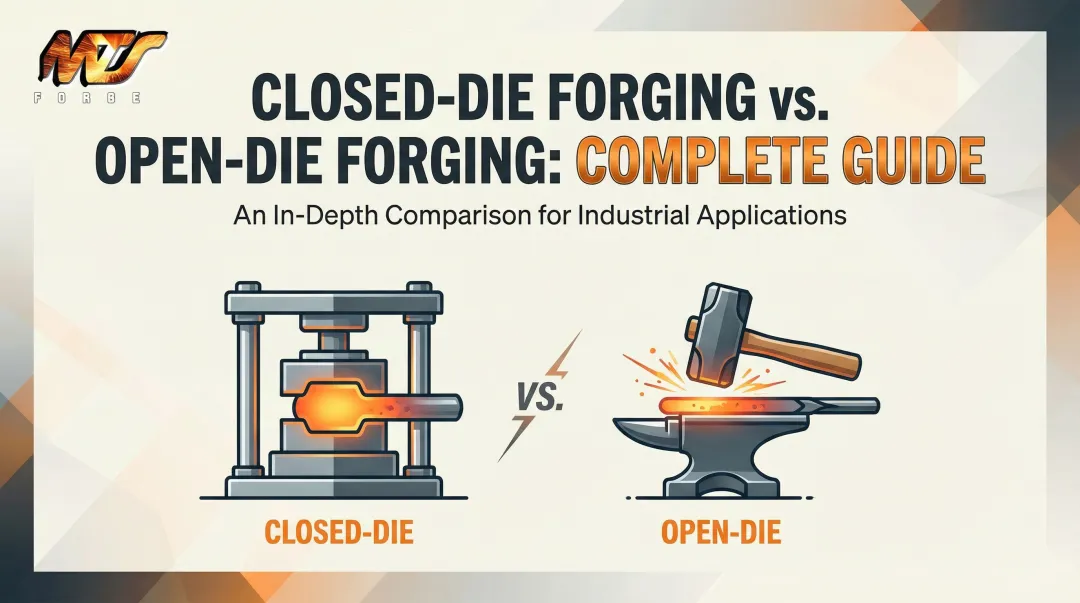
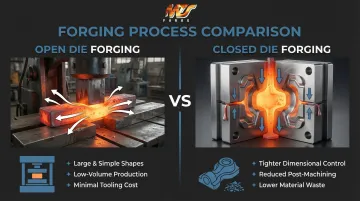
- Open die forging: Hammering between flat or simple dies for large or simple shapes. Best for low-volume production or extremely large components where complex geometry isn't required.
- Closed die (impression die) forging: Metal is pressed into a precision die cavity to achieve near-net shapes. This method, as practiced by MTS Forge, enables tighter shape control and reduces the need for extensive machining from bar stock, lowering both material waste and downstream processing costs.
Operational Advantages
Hot forming offers key process advantages:
- Retains formed shape without elastic springback after tooling release
- Produces uniform wall sections through controlled material flow
- Enables forming of titanium, Inconel, and stainless steel grades that cannot be cold formed
- Meets strict fatigue and impact resistance standards for aerospace, military, and power generation applications
Key Limitations
- Dimensional tolerances are less precise than cold forming due to thermal effects
- Cooling must be carefully controlled to prevent warping or cracking
- Energy costs for heating are significant
- Specialized tooling and temperature-controlled environments increase setup investment
Use Cases of Hot Forming
Hot forming is the process of choice when parts must survive extreme mechanical or thermal stress. Common applications include aerospace structural components, turbine blades and discs, defense hardware, pressure vessel fittings, and heavy industrial gears where grain integrity and ductility under load are non-negotiable.
For certain materials, hot forming is the only viable path: titanium alloys (Ti-6Al-4V), Inconel superalloys, and high-carbon or alloy steels. Cold forming these materials typically results in cracking or requires forming forces that exceed practical equipment capacity.
What is Cold Forming?
Cold forming—also called cold forging or cold working—shapes metal at or near room temperature using compressive force. Unlike hot forming, the grain structure does not recrystallize; instead, it elongates and aligns with the new shape.
This produces work hardening (strain hardening): plastic deformation increases dislocation density within the material, raising yield strength and hardness without any applied heat.
Common Techniques
Manufacturing operations employ several cold forming methods:
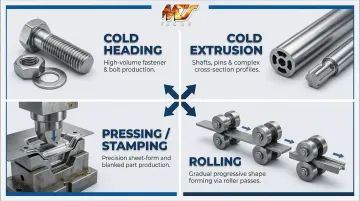
- Cold heading — produces fasteners (bolts, screws, rivets) at high volume
- Cold extrusion — forces metal through a die to create shafts, pins, and complex cross-sections
- Pressing/stamping — compresses metal between male and female dies for sheet-form parts
- Rolling — gradually shapes metal through sequential passes
Operational Advantages
The production economics favor cold forming in several ways:
- Machines run 300–400 strokes per minute for small components (8–12mm diameter), dropping to ~90 strokes per minute for larger diameters (27mm and above)
- The cut-off slug converts almost entirely into the finished part, generating near-zero scrap
- Dimensional accuracy typically eliminates secondary finishing operations
- Tooling lasts longer than hot forming dies because it operates without thermal stress
Material Constraints
Cold forming requires materials with high ductility and low strain hardening. Workable options include:
- Mild steel and low-carbon steel
- Aluminum and copper alloys
Medium carbon steels (0.30–0.60% carbon) are forging grades typically used in the heat-treated condition; cold forming is generally not practical for higher-carbon and alloy steels.
Work Hardening Tradeoff
Increased strength is a clear benefit, but excessive work hardening can reduce ductility until the part becomes brittle or requires intermediate annealing — adding cost and process steps. Engineers must weigh strength gains against the residual ductility the finished component needs.
Use Cases of Cold Forming
Cold forming dominates high-volume production environments where tight tolerances and consistent surface quality are non-negotiable: automotive drivetrains, industrial fastener production, and structural hardware applications.
Industries and products where cold forming is the standard choice include:
- Bolts, screws, rivets, and other fasteners
- Transmission components
- Cold-drawn tubing
- Thin-walled aluminum aerospace structural parts (using hydroforming or stamping methods)
Hot Forming vs. Cold Forming: Which Process Is Right for Your Application?
The decision between hot and cold forming hinges on four practical factors:
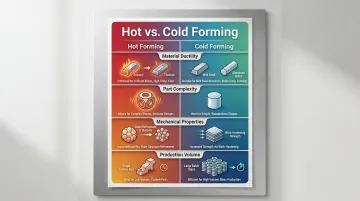
1. Material Type and Room-Temperature Ductility
If your material has low ductility at room temperature (titanium, Inconel, high-carbon steel, stainless steel), hot forming is often the only viable option. If you're working with mild steel, aluminum, copper, or low-carbon steel, cold forming becomes feasible.
2. Part Complexity and Geometry Requirements
Complex, three-dimensional geometries with deep recesses, sharp contours, or intricate custom shapes require hot forming. Simpler, standardized shapes with relatively uniform cross-sections are well-suited to cold forming.
3. Required Mechanical Properties
Cold-formed parts have higher yield and tensile strength due to work hardening, but hot-formed parts deliver superior ductility, fatigue resistance, and toughness through grain refinement. Which process produces a "stronger" part depends on the type of strength your application demands—for dynamic loading and high-stress environments, hot forging typically wins on overall structural integrity.
4. Production Volume and Total Cost of Ownership
High-volume production of standardized parts favors cold forming due to lower per-unit costs and minimal finishing requirements. Complex, custom, or lower-volume specialty parts benefit from hot forming, where the added energy cost is offset by the elimination of defects, reduced machining from bar stock, and superior material properties.
When to Choose Hot Forming
Choose hot forming when:
- The part is made from a difficult-to-form alloy
- Complex or custom three-dimensional geometry is required
- The part must meet high fatigue or structural performance standards
- The application is safety-critical (aerospace, defense, power generation)
MTS Forge specializes in closed-die hot forging for exactly these scenarios—safety-critical components in aerospace, defense, and power generation where material traceability, near-net-shape accuracy, and certifications like Mil I 45208 and NCA 3800 are non-negotiable.
When to Choose Cold Forming
Choose cold forming when:
- The material is highly ductile (mild steel, aluminum, copper)
- The geometry is relatively simple and standardized
- Production volume is high
- Dimensional precision and surface finish are priorities
Cold forming's economics favor large runs of consistent, near-net-shape parts where repeatability and minimal finishing are essential.
Conclusion
Hot forming and cold forming each solve a different engineering problem. Hot forming unlocks complex geometry, superior ductility, and the ability to work with difficult alloys. Cold forming delivers dimensional precision, surface quality, and high-volume efficiency with ductile materials.
The right choice is always application-driven. Four variables typically determine it:
- Material: Difficult alloys (Inconel, Monel, high-strength steels) generally require hot forming
- Part complexity: Intricate geometries favor hot; tight tolerances favor cold
- Mechanical properties: Hot forming improves grain structure; cold forming adds work-hardening strength
- Production volume: Cold forming's repeatability scales efficiently at high volumes
For manufacturers in aerospace, defense, or power generation, where component failure carries serious consequences, these process-level differences have direct bearing on part performance, material yield, and production economics. MTS Forge has built its closed-die and plate-forming work around exactly this kind of material and process knowledge — helping engineers in critical industries specify the right forming approach from the start.
Frequently Asked Questions
What is the difference between hot and cold forming?
Hot forming heats metal above its recrystallization temperature to make it plastic and malleable before shaping, while cold forming shapes metal at room temperature using compressive force. The key difference is how temperature affects grain structure, material flow, and the types of parts each process can produce.
What is the difference between hot forming and warm forming?
Warm forming operates at temperatures between cold and hot forming ranges—typically 200–800°C depending on the material. It reduces the force required versus cold forming while maintaining better dimensional control than hot forming, making it useful for materials too brittle for cold forming that don't require full recrystallization temperatures.
Is cold forging stronger than hot forging?
Cold forging produces higher yield and tensile strength through work hardening, but hot forging delivers superior ductility, toughness, and fatigue resistance through grain refinement. The right choice depends on loading conditions: static strength favors cold forming, while dynamic or impact loading typically favors hot forging.
What are the examples of hot forming?
Common examples include closed die forging of aerospace components, turbine discs, and defense hardware; open die forging of large shafts and rings; hot stamping of high-strength steel automotive parts; and hot extrusion of titanium and Inconel components.
What is an example of cold forming?
Common examples include cold heading of bolts, screws, and fasteners; cold extrusion of aluminum pins and shafts; stamping of automotive body panels and brackets; and drawing of copper wire and tubing—all produced at or near room temperature.
What is the difference between hot and cold formed steel?
Hot formed steel has a refined grain structure, higher ductility, and better fatigue resistance but looser dimensional tolerances and a rougher surface scale requiring finishing. Cold formed steel has tighter tolerances, better surface finish, and higher yield strength from work hardening, but is limited to lower-carbon steel grades and simpler shapes.