Introduction
Engineers and procurement teams frequently compare cold forged steel and carbon steel when specifying components — but this comparison involves an important nuance: carbon steel is a material category, while cold forging is a manufacturing process. Carbon steel can itself be cold forged, so the real question is whether a cold-forged component outperforms standard carbon steel stock for a given application.
The distinction matters operationally. Selecting the wrong form affects component strength, dimensional tolerances, fatigue life, and total cost — all critical in aerospace, defense, and power generation.
The scale of forging use reflects this. Many commercial aircraft contain more than 450 structural forgings, while cars and trucks may contain over 250, predominantly from carbon or alloy steel. Forging consistently delivers superior strength-to-weight ratios compared to machined bar stock.
This guide covers the mechanics of cold forging, what defines carbon steel, a side-by-side comparison across key performance factors, and a practical framework for choosing the right option for your application.
Key Takeaways
- Cold forging shapes steel at room temperature, increasing strength through work hardening and grain refinement — it's a process, not a material
- Carbon steel is a material defined by iron-carbon composition (0.05%–2% carbon), delivered as bar, plate, or sheet
- Cold forged components deliver higher tensile strength, tighter tolerances, better surface finish, and superior fatigue resistance vs. standard carbon steel stock
- Standard carbon steel is more cost-effective for structural, general fabrication, or lower-stress applications
- Choosing between them comes down to load conditions, precision requirements, production volume, and application criticality
Cold Forged Steel vs. Carbon Steel: Quick Comparison
| Factor | Cold Forged Steel | Carbon Steel (Standard) |
|---|---|---|
| Strength | Work hardening and grain flow alignment yield up to 50% higher tensile strength than machined equivalents; preferred for cyclic or high-load applications | Strength depends on carbon content and heat treatment; adequate for moderate-load structural or fabrication uses |
| Dimensional Precision | Tighter tolerances and smoother surface finish; often requires little or no secondary machining | Hot-rolled or as-drawn stock requires more machining to hit tight tolerances; surface scale must be removed before finishing |
| Material Utilization | 85–95% material utilization vs. 33% for machining from bar — significantly less waste | Lower material and processing cost per unit; widely available |
| Tooling & Setup Cost | Higher upfront tooling investment ($2,000–$100,000+); lower per-unit cost at volume | Minimal setup cost; shorter lead times for low-volume or large structural runs |
| Best Fit | High-volume precision parts, fatigue-critical components, complex near-net shapes | Low-volume production, large structural components, applications where forging tooling cost isn't justified |
What is Cold Forged Steel?
Cold forging is a metalworking process in which steel is shaped under high compressive force at or near room temperature (below the steel's recrystallization temperature), using dies and presses. Cold forged steel is not a steel grade — the feedstock is commonly medium or high carbon steel, alloy steel, or other grades chosen for the application.
How It Works: The Metallurgical Mechanism
At room temperature, compression increases dislocation density within the grain structure — a phenomenon called work hardening — which raises yield and tensile strength. X-ray analysis shows dislocation density increasing from 1.8 × 10¹¹ m⁻² to 5.4 × 10¹⁵ m⁻² after 40% cold work in austenitic stainless steel.
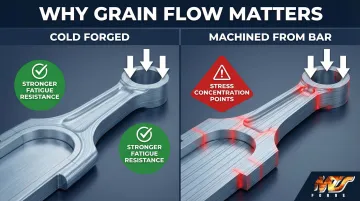
Forging also aligns grain flow with the shape of the part, improving fatigue resistance compared to machined or rolled components. Machining cuts across grain flow, creating discontinuities and weak points where stress concentrates under load. Forging avoids this entirely by preserving continuous grain structure.
Resulting performance characteristics:
- Higher surface hardness
- Improved fatigue life
- Excellent dimensional consistency
- Refined surface finish — all without adding heat
Process limitations: Cold forging is best suited to simpler, relatively compact geometries. Highly complex or thin-walled shapes may require hot forging or machining. Steels with high carbide content are more prone to cracking under cold reduction, so material selection is important.
Use Cases of Cold Forged Steel
Cold forging fits in a manufacturing workflow when producing high volumes of precision components that must meet tight dimensional specs and withstand repeated mechanical stress — reducing downstream machining time and material scrap.
Industries and component types where cold forged steel dominates:
- Aerospace: Fasteners, fittings, landing gear components requiring extreme fatigue resistance
- Automotive: Drivetrain parts (gears, shafts, connecting rods), suspension components
- Defense: Hardware requiring Mil-Spec compliance and stringent quality traceability
- Power generation: Components for nuclear and conventional plants where failure is not an option
- Hand tools: Wrenches, sockets, pliers requiring high hardness and durability
MTS Forge has produced custom cold-forged components for these industries since 1986, holding military certifications (Mil I 45208, Mil Q9858) and maintaining complete quality traceability across aerospace, defense, and power generation programs.
What is Carbon Steel?
Carbon steel is an iron-carbon alloy in which carbon content (typically 0.05%–2%) is the primary determinant of mechanical properties. Unlike alloy steels, carbon steel contains minimal deliberate alloying additions. The three main subtypes are:
| Type | Carbon Content | Characteristics |
|---|---|---|
| Low Carbon (Mild Steel) | Up to ~0.30% | Highly ductile, malleable, easily welded. Used for automobile doors, appliances, structural shapes |
| Medium Carbon | ~0.30%–0.60% | Balances ductility and strength; good wear resistance. Used for automotive components, gears, shafts |
| High Carbon | ~0.60%–1.50% | Very strong and hard, but poor ductility and weldability. Used for springs, cutting tools, high-strength wires |
How Carbon Content Drives Performance Trade-Offs
Higher carbon increases hardness and strength but reduces ductility and weldability. Medium and high carbon grades respond well to heat treatment (quench and temper), enabling precise adjustment of final mechanical properties. Global crude steel production reached 1.85 billion tonnes in 2025, with carbon steel accounting for the majority of output due to its versatility and cost-effectiveness.
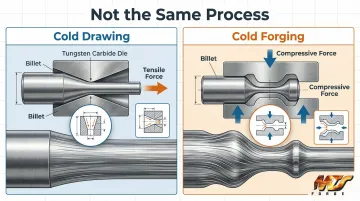
Carbon steel ships in standard forms — hot-rolled bar, plate, sheet, and cold-drawn bar — that reflect production and finishing methods, not forging. Cold-drawn bar is frequently confused with cold-forged steel. The distinction matters: drawing pulls material through a die using tensile force to reduce cross-section, while forging presses material into a shaped die using compressive force. The resulting grain structure and mechanical properties differ significantly.
Use Cases of Carbon Steel
Given those delivery forms, carbon steel fits best in manufacturing contexts where components are cut, welded, or formed directly from stock material rather than pressed to near-net shape.
Common industries and applications:
- Construction: Structural beams, plates, reinforcement
- Automotive: Body panels, frames, chassis components
- Pipelines: Oil, gas, and water transmission
- Agricultural equipment: Frames, implements, structural components
- General machinery: Housings, brackets, mounts
Cold Forged Steel vs. Carbon Steel: Which Should You Use?
The decision hinges on four key factors: load and stress conditions, dimensional precision requirements, production volume, and lifecycle cost vs. upfront budget. Cold forging is a manufacturing process, not a separate material — so the practical question is whether your application calls for a cold-forged component or a standard-form carbon steel part.
Choose Cold Forged Steel When:
- Cyclic loads, fatigue, or impact are factors — grain flow alignment from forging significantly improves fatigue resistance
- Tight tolerances are required and secondary machining costs need to stay low
- The application is safety-critical (aerospace, military, power generation) where reliability justifies higher upfront investment
- Production volume is sufficient to spread tooling costs across many parts (typically 3,000–10,000+ units)
Choose Standard Carbon Steel When:
- The application involves structural fabrication, large cross-sections, or general-purpose manufacturing
- Weldability and ease of fabrication are priorities
- The design requires shapes or sizes not practical for cold forging (very large components, complex internal features)
- Budget and lead time favor off-the-shelf stock for low-volume runs
The Cost-Efficiency Equation
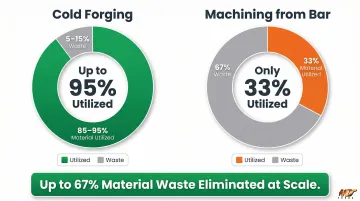
Cold forging reduces per-unit material waste and secondary machining, lowering total cost at scale despite higher tooling investment. Machining wastes up to 67% of input material, whereas cold forging typically wastes 8% or less, achieving material utilization rates of 85–95%. For expensive alloys run at high volume, that gap in material utilization can translate directly into thousands of dollars saved per production run.
Situational Decision Summary:
| Application Type | Preferred Form |
|---|---|
| Crankshafts, drivetrain gears | Cold forged steel |
| Aerospace fasteners, landing gear | Cold forged steel |
| Structural beams, building frames | Standard carbon steel |
| General-purpose flanges, plates | Standard carbon steel |
| High-fatigue suspension components | Cold forged steel |
| Welded fabrications, housings | Standard carbon steel |
Real-World Application: When Cold Forging Outperforms Standard Carbon Steel
Automotive Input Shaft Case Study
A manufacturer of motor-driven power steering (MDPS) systems faced quality inconsistency and excessive machining scrap using standard carbon steel bar stock. A peer-reviewed 2021 study evaluated converting the input shaft to a 6-stage multi-stage cold forging process using SWRCH45F steel (similar to AISI 1045).
Measurable improvements:
- Tensile strength rose 50%, from 500 MPa (machined) to 750 MPa (forged)
- Hardness improved 45% over the machined baseline
- Peak deformation under 200 Nm load dropped 60%, from 0.61 mm to 0.25 mm
- Fatigue limit climbed from 200 MPa to 300 MPa (50% gain); the forged shaft survived 1,000,000 cycles at 100 Nm torque while the machined version fractured before 1,000 cycles
Aerospace Fastener Case Study
A 2001 study in Engineering Failure Analysis investigated aeronautical stud bolts made from AISI 4340 alloy steel. Threads produced by cold-rolling (a cold forging process) delivered 4 times the fatigue lifetime compared to machined threads. Rolling threads after heat treatment introduced residual compressive stresses at thread roots and aligned the grain structure in the rolling direction. Both effects work together to slow crack initiation and stop crack propagation.
Takeaway: Cold forging is the right choice when load-bearing performance, tight tolerances, and production efficiency all matter — especially in aerospace, defense, and power generation applications. MTS Forge has produced custom cold-forged components since 1986, with in-house die design, Mil I 45208 and Mil Q9858 certifications, and a track record in America's most demanding supply chains. Contact MTS Forge to discuss your component requirements.
Conclusion
The comparison between cold forged steel and carbon steel is ultimately a question of manufacturing method vs. material form. Cold forging enhances whatever steel it processes; carbon steel defines what goes in. For components under demanding conditions — high fatigue, tight tolerances, safety criticality — cold forging consistently delivers superior performance. For structural fabrication and general manufacturing, standard carbon steel remains the practical, cost-effective choice.
The benefits differ by role:
- Aerospace and defense engineers gain fatigue life and dimensional confidence at safety-critical tolerances
- Power generation and automotive teams reduce per-part cost at volume through near-net-shape forging
- Procurement teams secure full material traceability and a documented quality chain
Matching process to application — not just selecting a material grade — is what separates a reliable component from a compromised one.
Frequently Asked Questions
Which is better, carbon steel or forged steel?
Forged steel (including cold forged) outperforms standard carbon steel in strength, fatigue resistance, and dimensional precision. However, standard carbon steel is often the better choice for structural or general fabrication work where those properties aren't required and cost efficiency matters more.
What is the difference between cold forging and hot forging?
Cold forging occurs at or near room temperature and strengthens steel through work hardening, while hot forging heats the steel above its recrystallization temperature for easier shaping. Cold forging produces tighter tolerances and better surface finish; hot forging is preferred for larger or more complex shapes.
Can carbon steel be cold forged?
Yes, carbon steel is commonly the feedstock for cold forging. Low-to-medium carbon grades are particularly well-suited. High carbon grades require careful process control to avoid cracking due to reduced ductility at room temperature.
Is cold forged steel stronger than standard carbon steel?
Cold forging increases tensile strength and hardness through work hardening and grain flow alignment. Cold forged components typically outperform equivalent carbon steel bar or plate, particularly under cyclic loading and fatigue conditions. Published studies document tensile strength improvements of up to 50%.
What are the main limitations of cold forging?
Key limitations include:
- Best suited for compact, relatively simple shapes — complex geometries are difficult to achieve
- Higher tooling costs require sufficient production volume to be economical
- Risk of cracking with high-carbon or high-carbide steels at significant cold reduction levels
What industries most commonly use cold forged steel components?
Aerospace, automotive, defense, power generation, and heavy equipment manufacturing are the primary users. These industries rely on cold forged components where high fatigue life, tight tolerances, and consistent mechanical properties outweigh the higher upfront tooling costs.