Introduction
Defense components operate under conditions that would destroy untreated metal in seconds. Military 20mm cannon cartridges generate chamber pressures up to 72,500 psi, while solid rocket motors withstand flame temperatures reaching 6,500°F and sustained chamber pressures above 800 psi. Artillery barrels absorb thermal shocks exceeding 1,350°F in firing cycles measured in seconds, not minutes. In these environments, material failure doesn't register as a defect—it manifests as mission failure.
In defense manufacturing, heat treatment is a precision metallurgical decision with life-critical consequences. The difference between a properly hardened missile casing and an under-tempered one shows up not in lab reports but in field reliability data and first-article inspection outcomes. When thermal processing is wrong, components fail structurally under operational load — not in controlled test conditions where corrections are still possible.
What follows covers what heat treatment delivers for defense components, which processes directly impact mission success, and what the consequences look like when thermal processing is compromised or skipped.
TL;DR
- Heat treatment modifies grain structure to achieve strength, toughness, hardness, and wear resistance raw alloys cannot deliver
- Structural forgings need hardening and tempering; nozzles need nitriding; ammunition requires case hardening for cycling durability
- Skipping or compromising heat treatment causes dimensional failures, accelerated wear, and structural breakdown under combat load
- Mil-Spec compliance and Nadcap accreditation define the quality baseline — process traceability is mandatory
- Closed-die forgings respond more uniformly to heat treatment than machined-from-bar alternatives, with less distortion risk
What Is Heat Treatment in Defense Component Manufacturing?
Heat treatment is the controlled heating and cooling of metal alloys to alter their internal grain structure and achieve target mechanical properties: tensile strength, hardness, toughness, and ductility. Unlike surface coatings or dimensional machining, heat treatment changes the metallurgical structure of the entire component.
In defense manufacturing, heat treatment applies across a wide range of mission-critical components:
- Structural forgings and missile casings
- Gun barrels and rocket nozzles
- Ammunition cartridges
- Drivetrain components in military vehicles and rotorcraft
The process serves one purpose: meeting exact material specifications that allow components to function under combat conditions where failure carries operational and safety consequences.
Heat treatment determines whether raw forged metal can meet these demands — or fail at the moment of use. A missile aft ring must contain detonation pressure without cracking. A gun barrel bore must resist erosion across thousands of firing cycles. An ammunition casing needs the ductility to flex under explosive pressure without splitting. These aren't tolerances that surface finishing can solve; they're built into the material itself.
Key Advantages of Heat Treatment for Defense Components
The three advantages below are grounded in measurable operational outcomes. Each directly impacts performance, compliance, or program cost in defense contracts.
Precisely Calibrated Strength and Toughness for Extreme Pressure Environments
Hardening and tempering allow manufacturers to dial in both tensile strength (to resist explosive pressure) and ductility (to resist shattering) simultaneously—a property combination raw or annealed metal cannot achieve. This dual-property profile is essential when a single component must withstand both static structural loads and dynamic shock within milliseconds.
How the process works:
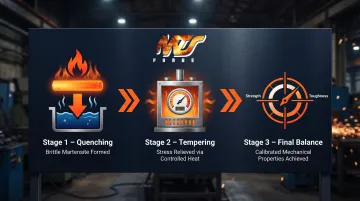
- Quenching: The forged component is heated above its transformation temperature and rapidly cooled (quenched) in oil, water, or polymer, forming a hard but brittle martensite structure
- Tempering: The part is reheated to a lower, controlled temperature and held, allowing the martensite to transform into tempered martensite—tough, ductile, and still strong
- Final balance: Time-temperature parameters determine the exact strength-toughness ratio, specific to the alloy and application
Why this matters operationally:
Spartan second-stage missile motor cases fabricated from 4340 steel exhibited yield strengths ranging from 212 to 265 ksi and fracture toughness from 48.6 to 58.6 ksi·√in. Vacuum-remelted 300M alloy steel (AMS 6417) achieves minimum tensile strength of 270 ksi and yield strength of 220 ksi after normalizing, hardening, and double-tempering, while maintaining Charpy impact values of 15.5 to 17.0 ft-lbs.
When this strength-toughness balance fails, the result is catastrophic. A missile casing that cracks under pressure or a cartridge that splits during firing represents mission failure, not just part rejection. High-pressure ordnance components operate with zero margin for metallurgical error.
Key performance indicators impacted:
- Tensile strength rating
- Yield strength
- Charpy impact value (toughness)
- Rejection rate at final inspection
- Field failure rate
When this advantage matters most: High-pressure ordnance (missile closures, aft rings, cartridge casings), structural airframe forgings, and any component absorbing both static load and dynamic shock in a single event.
Surface Hardness Without Sacrificing Core Toughness
Case hardening processes—carburizing and nitriding—create a wear-resistant outer shell over a tough, ductile core. This dual-property profile cannot be produced by machining or base alloy selection alone.
How case hardening works:
- Carburizing: Carbon diffuses into the metal surface under heat (typically 1,650°F to 1,700°F), creating a hardened outer case upon quenching. Effective case depth (ECD) to 50 HRC typically ranges from 0.020 to 0.080 inch depending on cycle time
- Nitriding: Nitrogen diffuses into the surface at lower temperatures (950°F to 1,050°F), forming extremely hard iron nitrides without requiring a quench that could distort precision-machined features. Surface hardness reaches 92.1 HR15N on H11/H13 tool steels, with case depths up to 0.035 inch
Operational impact:
Gas nitriding of gun barrel bores produces approximately 10% improvement in erosion resistance. Dynamic nitriding from high-nitrogen propellants raises the surface melt temperature from 1,423K (iron carbide) to 1,683K (iron nitride)—a shift that cuts erosion rates measurably. Pre-nitriding steel bores before applying refractory coatings protects the interface and reduces chemical erosion once the coating cracks under thermal cycling.
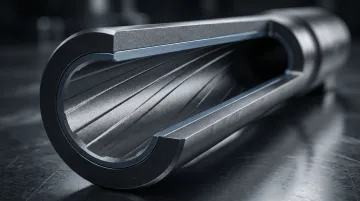
For ammunition and firearm components, case hardening ensures cycling reliability without brittleness. A cartridge that must flex under 60,000+ psi chamber pressure but resist feeding mechanism wear requires surface hardness on extraction surfaces and core toughness to contain detonation.
Key performance indicators impacted:
- Surface hardness (Rockwell HRC or HR15N)
- Wear rate
- Component service life
- Field maintenance frequency
When this advantage matters most: High-cycle components (firearm actions, ammunition feeders), parts exposed to erosive gas flow (rocket nozzles, blast tubes), and components where surface contact wear is the primary failure mode.
Dimensional Stability and Specification Conformance Across Production Runs
Stress relief—either standalone or incorporated into the heat treatment sequence—eliminates residual internal stresses introduced during forging and machining. Without stress relief, parts warp, drift dimensionally, or crack after leaving the furnace.
In practice, the difference is straightforward:
- A part that holds tolerance inspects correctly, assembles without interference, and moves cleanly through final assembly
- A part that distorts after heat treatment requires rework, re-inspection, or scrapping — adding cost, schedule risk, and the possibility that non-conforming parts reach the field
Cost of dimensional non-conformance in defense programs:
| Program | Issue | Cost Impact | Schedule Impact |
|---|---|---|---|
| USS San Antonio (LPD 17) | Quality/manufacturing deficiencies | $846 million overrun | 3-year delay |
| Expeditionary Fighting Vehicle | Assembly non-conformances | $750 million overrun | 4-year delay |
| AEHF Satellites | Defective electronic parts | $250 million retest cost | 24-month delay |
| F-22A | Manufacturing/quality escapes | $400 million overrun | Grounded flight tests |
A documented case from 1988 illustrates the consequence: a subcontractor machined HARM missile launch lugs using a new cutting tool but failed to inspect dimensions after heat treatment (which relieves stress). This resulted in 30 rocket motor cases with undersized lug slots, forcing recall of 5 units already shipped to Navy and Air Force installations.
Key performance indicators impacted:
- Dimensional conformance rate
- Rework and scrap rate
- Inspection pass rate
- Cost of quality
- Program schedule variance
When this advantage matters most: Precision-machined mating components with tight stack-up tolerances, high-volume production programs where lot-to-lot variability must be minimized, and programs subject to government source inspection or first-article testing.
What Happens When Heat Treatment Is Skipped or Compromised
Heat treatment is one of the first areas cut under cost pressure in competitive defense contracting: shortened soak times, unvalidated furnace profiles, non-certified facilities. The consequences rarely appear at inspection. They surface under operational load, often in the field.
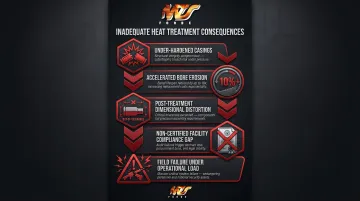
Failure cascade when heat treatment is inadequate:
Under-hardened casings and cartridges cannot contain detonation pressure, producing critical failure at the moment of use. A 1988 Sparrow missile investigation found bracket springs over-hardened to excessive tensile strength — 2,728 springs had to be replaced across fielded missiles.
Insufficient case depth or hardness accelerates wear in high-cycle components. Gun barrels without proper nitriding erode at rates 10% higher than treated counterparts, compressing maintenance cycles and reducing availability.
Unrelieved residual stress causes post-treatment distortion that produces parts failing dimensional inspection. The HARM missile launch lug failure traced back to a skipped post-heat-treat inspection step, allowing 30 non-conforming motor cases into assembly.
Non-certified facilities and undocumented processes eliminate the ability to verify material properties after the fact. A 2016 DoD Inspector General report cited DLA Aviation for failing to obtain restitution across 269 national stock numbers where contractors delivered defective parts — a compliance liability that extended program-wide.
A component that clears visual and dimensional inspection can still fail under operational load if the heat treatment process was compromised. When that happens in the field, the failure rarely stays contained to the component.
How to Get the Most Value from Heat Treatment in Defense Manufacturing
Heat treatment specifications must be engineered into the component from the design stage—not added as an afterthought. Alloy selection, component geometry, and heat treatment process are interdependent; changing one affects the others.
Work with suppliers whose teams include genuine metallurgical expertise—not just furnace operators, but engineers who understand how grain flow developed during forging affects thermal response and how to write heat treatment specs that consistently achieve target mechanical properties.
MTS Forge's co-founders, Stephen Carr and Edward Waddell, bring metallurgical backgrounds spanning nearly four decades of forging practice, directly informing how each part is specified and produced to meet defense requirements.
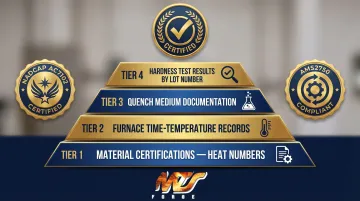
Require full process traceability as a contractual baseline:
- Material certifications with heat numbers
- Furnace time-temperature records
- Quench medium documentation
- Hardness test results tied to specific lot numbers
These requirements aren't new—legacy standards Mil I 45208 and Mil Q9858 enforced exactly this level of documentation before both were cancelled in 1996 without replacement. Today, prime contractors fill that gap directly: Nadcap accreditation (AC7102) and AMS2750 pyrometry compliance are now standard mandates. Lockheed Martin Rotary and Mission Systems, for example, requires all heat treat operations to be performed by Nadcap-certified sources with minimum AS9003 QMS.
Validate through testing, not assumption:
- Destructive testing: cross-section hardness traverses, tensile samples
- Non-destructive evaluation: magnetic particle, ultrasonic
- Link results to documented production lots, not one-time first article data
Why Closed-Die Forgings Respond Better to Heat Treatment
Closed-die forgings enter heat treatment with refined, directional grain structure and near-net shapes. They respond more consistently to thermal cycles and produce more uniform mechanical properties than machined-from-bar alternatives. In one comparative study, gears forged with integral teeth demonstrated average cycles-to-failure more than seven times higher than gears machined from bar stock.
The continuous grain flow established in closed-die forging virtually eliminates residual stresses in critical features, resulting in substantially higher component life and more predictable heat treatment response.
Conclusion
Heat treatment in defense component manufacturing is not a finishing step or a commodity service—it is the engineering process that determines whether a part meets specification, survives operational conditions, and supports mission success.
The advantages of properly executed heat treatment— strength calibration, surface durability, dimensional conformance, and fatigue resistance — build over a program's lifecycle when applied consistently and verified through traceable quality systems. That cumulative effect makes heat treatment one of the highest-leverage quality decisions in defense sourcing.
Treat heat treatment as an ongoing engineering discipline, not a one-time production checkbox. The manufacturers worth partnering with on defense programs are those whose metallurgical depth and Mil-Spec certifications — Mil I 45208, Mil Q9858 — are already embedded in how they work, not added on request. MTS Forge has operated that way since 1986.
Frequently Asked Questions
What are the 5 heat treatment processes?
The five primary processes are annealing (softening and stress relief), normalizing (grain refinement), hardening (quenching for maximum hardness), tempering (post-quench toughness recovery), and case hardening (surface hardness via carburizing or nitriding). Each targets a different mechanical outcome based on application requirements.
What metals cannot be heat treated?
Pure metals and non-ferrous alloys — copper, pure aluminum, most lead alloys — have limited or no response to conventional heat treatment. Some stainless steels and work-hardened alloys are also excluded from standard thermal methods, so alloy selection must be determined before design is finalized.
What is T4 and T6 heat treatment?
T4 and T6 are temper designations for aluminum alloys: T4 is solution heat-treated and naturally aged at room temperature, while T6 is artificially aged at elevated temperature for higher strength. T6 is the standard choice for aerospace and defense aluminum structural components.
Why is heat treatment critical for military and defense components?
Defense components operate under extreme pressure, temperature, and shock conditions that raw metal cannot withstand. Heat treatment provides the precise strength-toughness balance, surface durability, and dimensional stability that allow components to perform reliably in mission-critical environments where component failure can compromise mission outcomes.
What military standards govern heat treatment of defense parts?
MIL-I-45208A and MIL-Q-9858A were superseded in 1996; defense suppliers now operate under ISO 9001:2015 or AS9100. Prime contractors also mandate Nadcap accreditation (AC7102), which requires AMS2750 pyrometry compliance, documented personnel training, and full process traceability.
How does the forging process affect heat treatment outcomes?
Forged components enter heat treatment with refined, directional grain structure produced by the deformation process. This makes them respond more uniformly to thermal cycles and achieve more consistent mechanical properties than castings or machined-from-bar alternatives, reducing variability and improving process yield across production runs.