What is normalizing heat treatment and why is it important for defense forgings?
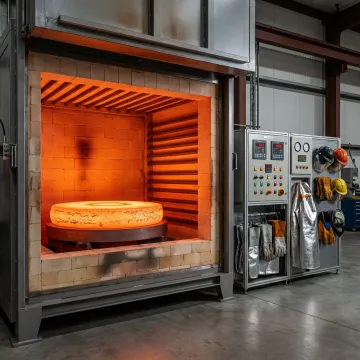
Normalizing is a heat treatment process where a forged component is heated above its upper critical temperature and then air-cooled at room temperature. The forging process creates uneven grain growth and internal stresses; normalizing breaks up these irregular structures to produce a refined, uniform microstructure with improved tensile strength, toughness, ductility, and machinability—properties that are mandatory in defense-grade components.
Is your heat treatment process compliant with military quality standards?
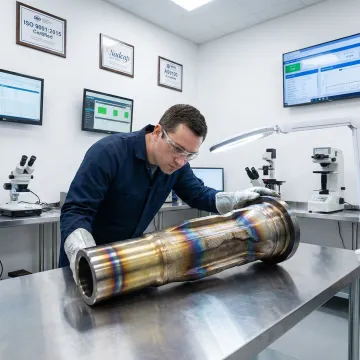
Yes. MTS Forge operates under a comprehensive Quality Assurance Program that includes certifications to Mil I 45208 and Mil Q9858. These standards govern inspection and quality system requirements for defense manufacturing, ensuring that every heat-treated forging is produced, documented, and traceable to the level of rigor required by military procurement specifications.
What materials can you heat treat?
MTS Forge applies normalizing heat treatment across its full range of working materials, including alloy steels, stainless steels such as 316-L, high-performance alloys like Monel K-500, Ferralium 255 duplex stainless steel, and other specialty alloys. This breadth supports defense contractors sourcing components in non-standard or high-performance materials for demanding operational environments.
Is heat treatment performed in-house or outsourced?
Heat treatment is performed entirely in-house at MTS Forge's Coatesville, Pennsylvania facility. This eliminates the risk and delays associated with outsourcing thermal processing to a third party, maintains the chain of custody for quality traceability, and allows heat treatment to be sequenced immediately after forging or rough machining for faster turnaround on defense contracts.
What forging types and sizes are eligible for heat treatment?
MTS Forge applies heat treatment across its full range of forged products, including closed die forgings, upset forgings, rings and cylinders up to 26 inches in diameter and 1,500 pounds, contour forgings, flanges up to 14 inches, manways, special forgings, and custom-forged components. Both standard and non-standard geometries produced at the facility can be normalized post-forging.
Can MTS Forge provide complete traceability documentation for defense procurement?
Yes. MTS Forge's Quality Assurance Program provides complete traceability throughout the production process, from raw material receipt through forging, heat treatment, and machining. Documentation packages can be compiled to satisfy defense contractor and military procurement requirements, including material certifications, heat treatment records, and dimensional inspection reports aligned with applicable MIL-SPEC standards.
Do you offer rough machining after heat treatment?
Yes. In-house rough machining is available immediately following heat treatment. This service removes excess material from as-forged and heat-treated parts, bringing components close to near-net shape and eliminating the need for defense contractors to source a separate machining vendor. This reduces lead times, lowers handling risk, and keeps more of the production process under one quality-controlled roof.
Which industries does MTS Forge serve beyond defense?
In addition to defense and military contractors, MTS Forge serves aerospace, commercial nuclear, power generation, chemical processing, machine manufacturing, agriculture, construction, and gas and petroleum industries. Many of these sectors share the same demand for microstructural integrity and mechanical reliability that drives heat treatment requirements in defense applications, making MTS Forge's capabilities broadly transferable across high-stakes industries.