What nickel alloy is used in aircraft?
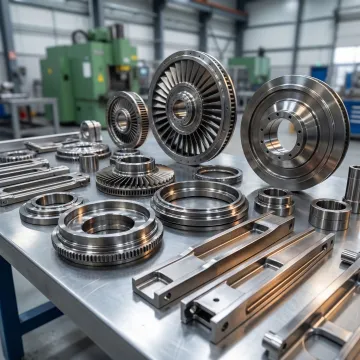
The most commonly used nickel alloys in aircraft include INCONEL 718, INCONEL 625, Waspaloy, and Monel K-500. These alloys are selected for their exceptional resistance to heat, oxidation, and mechanical fatigue. INCONEL 718 is particularly prevalent in turbine discs and engine components, while Monel K-500 is favored for fasteners and structural parts requiring corrosion resistance combined with high strength.
Why is INCONEL used in aerospace?
INCONEL is used in aerospace because it retains exceptional strength and oxidation resistance at temperatures exceeding 1,000°F — conditions that would cause standard steels and aluminum alloys to degrade rapidly. Its face-centered cubic crystal structure resists creep deformation under sustained stress, making it ideal for turbine blades, exhaust systems, combustion chambers, and other high-temperature engine components where structural failure is not an option.
What quality certifications does MTS Forge hold for aerospace nickel alloy forgings?
MTS Forge's Quality Assurance Program is certified to Mil I 45208, NCA 3800, and Mil Q9858 — standards that mandate rigorous inspection, documentation, and complete material traceability. These certifications are specifically recognized by aerospace and defense procurement teams as evidence of controlled, auditable manufacturing processes suitable for mission-critical components.
What nickel alloy forging capabilities does MTS Forge offer for aerospace applications?
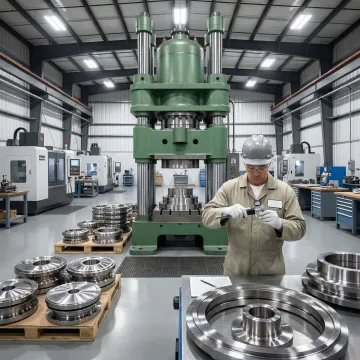
MTS Forge offers closed die forgings, upset forgings, rings, cylinders, contour forgings, and custom-shaped forgings in nickel alloys including Monel K-500. Maximum forging diameter is 26 inches with a per-piece weight capacity of up to 1,500 lbs. In-house heat treatment, rough machining, and tooling design are also available, enabling a complete production sequence under one roof.
How does closed die forging reduce costs for aerospace nickel alloy components?
Closed die forging creates parts in near-net shape by compressing material within a precision die cavity, which significantly reduces the volume of expensive nickel alloy starting material required. Compared to machining a part from solid bar stock, this approach can cut raw material consumption by 30–60% and reduce machining time, lowering total unit cost for high-volume or high-value aerospace programs.
What is the role of heat treatment in nickel alloy aerospace forgings?
Heat treatment — specifically normalizing — is applied after forging to eliminate the uneven grain growth and internal stresses introduced by the forging process. For nickel alloys used in aerospace, this produces a uniform microstructure with consistent tensile strength, enhanced toughness, and improved machinability. MTS Forge performs normalizing in-house at its Coatesville, PA facility across the full range of alloy materials it produces.
Does MTS Forge produce Made-in-America nickel alloy forgings for defense and aerospace?
Yes. All MTS Forge forged components, including nickel alloy parts for aerospace and defense, are manufactured at the company's facility in Coatesville, Pennsylvania. Domestic production supports supply chain compliance requirements for defense and aerospace programs that mandate U.S.-origin material sourcing and traceable manufacturing documentation from raw material receipt through final inspection.
What industries does MTS Forge serve beyond aerospace with nickel alloy forgings?
In addition to aerospace, MTS Forge supplies nickel alloy and high-performance alloy forgings to the defense, commercial nuclear, power generation, chemical processing, medical, and gas and petroleum industries. The company's quality infrastructure — including full material traceability and military-grade QA certification — makes its forgings suitable for any application where dimensional accuracy and material integrity are mandatory.