Introduction: Stainless Steel in Power Generation
Power generation equipment operates in some of the harshest conditions imaginable. Reactor cores, boiler superheaters, geothermal wells, and offshore wind platforms must withstand extreme temperatures, crushing pressures, corrosive fluids, and in some cases, neutron radiation—often simultaneously—for decades without failure. According to IAEA technical documents, typical PWR pressure vessels must endure 15.51 MPa (2,250 psi) and temperatures reaching 325°C (617°F) continuously throughout their operational lifetime.
Material selection under these conditions directly determines plant safety, reliability, and lifecycle economics—a wrong choice means early failure, costly downtime, or worse. Stainless steel dominates across virtually every power generation technology, from nuclear reactors to wind turbines, precisely because no other common structural material matches its combination of corrosion resistance, high-temperature strength, and long-term mechanical stability. Understanding which grades go where, and how they're manufactured, is what separates components that last from those that don't.
Key Takeaways
- Stainless steel's chromium oxide passive layer resists corrosion in the harshest power generation environments, from nuclear primary circuits to offshore wind platforms
- Austenitic 304/316 grades suit general applications; duplex grades deliver double the strength; nuclear variants add low-carbon chemistry
- Applications span nuclear reactors, fossil fuel plants, wind turbines, geothermal systems, and hydroelectric facilities
- Choose forged components over cast or bar-machined parts for superior grain structure and fatigue strength — a meaningful difference in safety-critical systems
- Longer service life and full recyclability outweigh higher upfront material cost
Why Stainless Steel Excels in Power Generation Environments
The Self-Healing Passive Layer
Stainless steel's signature advantage stems from its passivation mechanism. Any alloy containing at least 10.5% chromium spontaneously forms a thin, transparent chromium oxide layer when exposed to oxygen. This passive film self-heals within seconds if scratched or damaged, providing continuous protection against oxidation, moisture, acids, and chlorides.
In power generation, that translates to reliable performance across environments ranging from high-pressure steam circuits (where carbon steel would scale and corrode) to coastal wind farm atmospheres laden with salt spray.
High-Temperature Strength Retention
Austenitic stainless steels maintain useful structural strength at operating temperatures where carbon steels experience creep deformation or catastrophic oxidation failure. Grades like 304H and 316H retain adequate tensile strength up to approximately 650–700°C, making them the standard choice for:
- Boiler superheater and reheater tubes
- Steam piping headers
- Turbine casings
- Heat exchanger tube bundles
For nuclear applications, austenitic nuclear-grade alloys must perform reliably at the 280–325°C operating temperatures typical of PWR primary circuits, while simultaneously resisting radiation-induced embrittlement.
Mechanical Versatility Across Temperature Extremes
Stainless steel maintains tensile strength, ductility, and impact toughness from cryogenic liquefied gas storage (-196°C) all the way to superheated steam service above 700°C. That range lets engineers design thinner, lighter components without sacrificing safety margins. The practical result: reduced structural weight in offshore wind platforms and more compact heat exchanger designs in combined-cycle plants.
Fabricability for Complex Geometries
Power plants require thousands of specialized components. Stainless steel welds, forges, machines, and forms into complex geometries while retaining its corrosion resistance — a flexibility that matters across the full range of shapes modern power plants demand, including:
- Flanges and valve bodies
- Piping elbows and turbine nozzles
- Instrumentation fittings
Lifecycle Economics
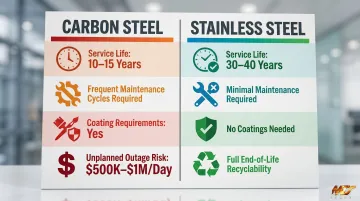
While stainless steel costs more upfront than carbon steel, the total lifecycle cost equation consistently favors stainless. Extended component service life, reduced maintenance frequency, elimination of protective coatings, and full recyclability at end-of-life create compelling economics. Unplanned outages at utility-scale power plants cost $500,000 to over $1 million per day in lost generation revenue, so a component that lasts decades without coating or replacement pays for the premium many times over.
Stainless Steel Grades Used in Power Generation
Austenitic Workhorses: 304 and 316
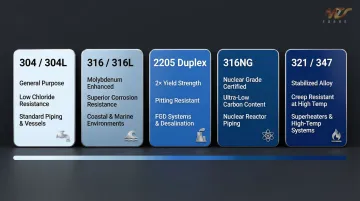
Type 304/304L contains approximately 18% chromium and 8% nickel. The "L" variant restricts carbon to ≤0.03% to prevent weld sensitization (chromium carbide precipitation at grain boundaries). 304 suits general structural applications, piping, and vessels where chloride exposure is minimal.
Type 316/316L adds 2–3% molybdenum to the 304 composition, significantly improving resistance to chloride-induced pitting and crevice corrosion. This makes 316L the standard choice for:
- Coastal power plants with seawater cooling systems
- FGD (flue gas desulfurization) absorber components
- Marine environments and offshore platforms
Duplex and Super-Duplex Grades
Duplex stainless steels like 2205 combine austenitic and ferritic microstructures, delivering roughly double the yield strength of standard austenitic grades. Super-duplex grades like 2507 push further, offering superior resistance to chloride stress corrosion cracking. Typical applications include:
- FGD system absorber vessels and spray headers
- Offshore wind turbine structural supports
- Geothermal piping handling aggressive brines
- Hydroelectric turbine components
The higher strength-to-weight ratio allows thinner, lighter designs. For offshore installations, that weight reduction translates directly into lower foundation costs.
Nuclear-Grade and High-Temperature Variants
Nuclear applications demand ultra-low carbon austenitic grades to minimize sensitization and resist irradiation-assisted degradation. According to NRC Regulatory Guide 1.44, low-carbon grades (≤0.03% C) should be specified for reactor coolant contact to prevent intergranular stress corrosion cracking.
Grade 316NG takes this further, restricting carbon below 0.02% while adding nitrogen (N+C < 0.12%) to maintain strength without sensitization risk. It resists Irradiation-Assisted Stress Corrosion Cracking (IASCC), which becomes a concern at neutron fluences exceeding ~3 dpa (displacements per atom) in PWRs.
For extreme high-temperature service, two stabilized grades prevent sensitization by tying up carbon in stable carbides rather than chromium carbides:
- Grade 321 — titanium-stabilized; used in superheater tubing and exhaust components
- Grade 347 — niobium-stabilized; preferred where higher temperature strength is required
Applications: How Stainless Steel Powers Modern Energy Systems
Nuclear Power Plants
Primary circuit components in PWR plants operate at 15.51 MPa pressure and 280–325°C continuously, with constant exposure to intense neutron radiation. Austenitic nuclear-grade stainless steel (304NG, 316L) is the standard material for:
- Reactor vessel internals
- Primary coolant piping
- Pressurizer components
- Control rod drive mechanisms
These materials must resist irradiation-assisted stress corrosion cracking, which can initiate at stresses as low as 40–60% of yield strength in highly irradiated material (>30 dpa). Components in nuclear service require full material traceability and compliance with ASME Section III NCA-3800. MTS Forge holds that certification, qualifying the company as a supplier for safety-critical nuclear forgings.
Spent fuel storage and steam generator tubing rely on stainless steel's corrosion resistance in borated water and its structural stability under radiation. These components must maintain integrity for decades in chemically controlled pool water while subjected to residual radiation from spent fuel assemblies.
Fossil Fuel and Combined-Cycle Plants
High-temperature boiler components — superheater and reheater tubes, economizers, and heat exchangers — operate in oxidizing flue gas environments where temperatures routinely exceed 550°C and thermal cycling induces fatigue stresses. Grades 304H and 316H, with higher carbon for improved creep strength, are specified for these services.
Flue gas desulfurization (FGD) systems present one of power generation's most corrosive environments: acidic limestone slurry combined with chloride-laden flue gas condensate. This mixture destroys carbon steel within months. Austenitic 316L and duplex 2205 are the established materials for:
- Absorber vessel shells and internals
- Slurry spray headers and piping
- Mist eliminator assemblies
- Ductwork downstream of the absorber
The molybdenum content in 316L and the duplex microstructure in 2205 provide the chloride resistance essential for multi-decade FGD system operation.
Renewable Energy Systems
Fossil fuel plants demand corrosion and creep resistance; renewable systems add extreme environmental exposure to that list. From offshore platforms to underground brines, the material requirements shift — but stainless steel remains the common answer.
Offshore wind turbines face salt spray, high humidity, and continuous temperature cycling. Duplex stainless steel is the go-to grade for nacelle hardware, high-strength fasteners, and structural supports. Offshore turbines are designed for 20–25 year service lives, and corrosion resistance is what determines whether that design life is achieved without major refurbishment.
Geothermal and hydroelectric applications each present distinct challenges:
- Geothermal brines carry dissolved H₂S, CO₂, and chlorides at temperatures up to 300°C — conditions that destroy standard austenitic grades through sulfide stress cracking and pitting. Super-austenitic grades (6% molybdenum alloys) and super-duplex 2507 handle wellhead equipment, piping, and heat exchanger components.
- Hydroelectric turbine runners rely on stainless steel's cavitation resistance and toughness. Austenitic and duplex grades withstand both the corrosive action of river or reservoir water and the impact stresses from debris in high-flow conditions.
The Forging Advantage for Power Generation Components
Microstructural Refinement Through Forging
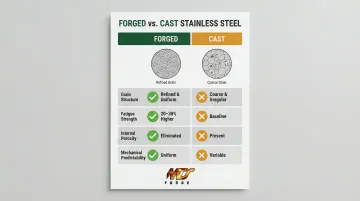
Closed-die forging fundamentally transforms stainless steel's internal microstructure. Unlike casting or machining from bar stock, forging works the metal under controlled pressure to produce a denser, more uniform grain structure. The process:
- Refines grain structure through controlled plastic deformation
- Aligns grain flow to match the component's final shape
- Eliminates internal porosity common in castings
- Produces superior fatigue strength and impact resistance
For safety-critical power generation hardware, these metallurgical improvements are essential. Forged components demonstrate:
- 20–30% higher fatigue strength than castings
- Improved ductility and impact toughness
- Predictable, uniform mechanical properties
- Elimination of casting defects (shrinkage porosity, inclusions)
Critical Forged Components in Power Plants
Specific power generation components are typically specified as forgings due to their safety-critical nature:
Pressure-containing components:
- Valve bodies for main steam and feedwater systems
- Flanges for primary circuit connections
- Pump housings for reactor coolant and feedwater pumps
- Pressure vessel nozzles and penetrations
High-stress rotating components:
- Turbine bolting and fasteners
- Shaft components
- Coupling flanges
Safety system components:
- Emergency core cooling system fittings
- Containment isolation valve bodies
Failure of any of these components under pressure or cyclic loading could trigger catastrophic plant events, making the superior grain structure and mechanical properties of forgings a fundamental safety requirement.
Material and Cost Efficiency
Closed-die forging creates near-net shapes, meaning significantly less raw material is machined away compared to starting from solid bar stock. A complex valve body forged to shape retains 70–85% of starting material; machining the same part from bar stock typically yields only 30–40% utilization. With austenitic stainless alloys running $5–15 per pound (and duplex grades higher), that difference in retained material adds up quickly—often recovering tooling costs within moderate production runs.
Manufacturing Expertise: MTS Forge
Founded in 1986 by engineers with metallurgical backgrounds, MTS Forge has spent four decades manufacturing custom closed-die forgings for power generation, nuclear, and defense applications. The company holds NCA 3800 certification—the ASME quality standard required for nuclear-grade material suppliers. In-house tooling design and a large existing die inventory mean MTS Forge can produce complex near-net shapes without the lead times or material waste that come with machining from bar.
The company manufactures forgings in all common power generation grades—304/304L, 316/316L nuclear-grade variants, and duplex alloys—with full material traceability and comprehensive quality documentation. For power plant engineers and procurement teams, NCA 3800 certification paired with complete material traceability documentation means every forging arrives with the audit trail required for ASME compliance and plant safety records.
Lifecycle Benefits and Sustainability of Stainless Steel in Power Generation
Durability and Reduced Downtime
Extended component service intervals mean fewer planned outages and virtually eliminate costly unplanned failures. Stainless steel piping, valve bodies, and heat exchanger components routinely achieve 30–40 year service lives in corrosive power plant environments where carbon steel equivalents require replacement every 10–15 years. The financial impact is substantial: unplanned outages at utility-scale power plants cost operators $500,000 to over $1 million per day in lost generation revenue, making component reliability a direct bottom-line issue.
Sustainability Credentials
Stainless steel is 100% recyclable at end of service life with no degradation of material properties. Modern stainless steel production incorporates 60–80% recycled scrap content, reducing primary resource extraction. As power utilities face growing environmental reporting requirements and sustainability mandates, the recyclability and resource efficiency of stainless steel align with corporate environmental commitments.
Future-Facing Applications
That sustainability profile carries into the next generation of power infrastructure. Stainless steel is seeing growing demand across emerging clean energy technologies:
- Advanced reactors (SMRs, molten salt, fast reactors) require corrosion-resistant components for high-temperature, high-radiation environments
- Green hydrogen production via electrolysis depends on stainless steel for electrolyzers and high-pressure hydrogen piping
- Utility-scale energy storage — compressed air, liquid air, and molten salt thermal systems — relies on stainless steel for containment and heat transfer
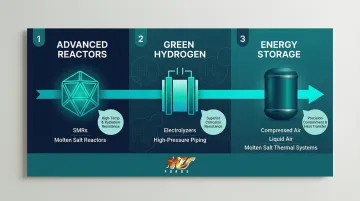
Stainless steel isn't just keeping legacy plants running. It's a core material in the clean energy infrastructure being built right now.
Frequently Asked Questions
What kind of stainless steel is used in nuclear reactors?
Low-carbon austenitic grades—primarily 304L and 316L in nuclear-grade (NG) variants—are standard for reactor internals and primary circuits. These are selected for resistance to radiation-induced sensitization and irradiation-assisted stress corrosion cracking, with strict chemistry and traceability requirements per ASME NCA-3800 nuclear quality standards.
What are three types of stainless steel tubing?
The three common types used in power plants are:
- Seamless tubing — highest integrity, preferred for pressure service
- Welded tubing — cost-effective for lower-pressure applications
- Instrumentation/capillary tubing — small-diameter, tight-tolerance products for sensing and control systems
What is the strongest steel tubing?
"Strongest" depends on the property measured. Duplex and super-duplex grades lead in yield strength (80–120 ksi), while precipitation-hardening grades like 17-4 PH reach the highest tensile strength (190+ ksi). Both see use in demanding power generation and aerospace applications.
Can electricity pass through stainless steel?
Yes, stainless steel conducts electricity like all metals, but its electrical conductivity is significantly lower than copper or aluminum. In power generation, stainless steel is used for its structural and corrosion-resistant properties in containment, piping, and pressure boundaries—not as an electrical conductor.
What metal will never rust?
No metal is entirely immune to corrosion under all conditions. Stainless steel's chromium oxide passive layer makes it highly resistant to rust in most environments, and higher-grade alloys (duplex, super-duplex, 316) hold up even in aggressive marine, geothermal, and chemical service where carbon steel fails rapidly.