

Introduction
Picture a maintenance technician facing a 20-foot pressure vessel in a chemical plant, needing to inspect the interior for corrosion. There's no drain valve large enough, and cutting into the vessel isn't an option. The solution? A manway—a reinforced access opening that allows safe entry without compromising vessel integrity.
Manways are essential but underappreciated components in industrial infrastructure. From breweries and pharmaceutical plants to nuclear power stations and underground fuel storage, these engineered access ports make routine maintenance, inspection, and cleaning possible. Without them, operators would face costly shutdowns, vessel dismantling, or dangerous workarounds.
This article covers what a manway is, how it works, the types available, common applications, and how manways differ from manholes.
TLDR: Key Takeaways
- Definition: Reinforced access openings built into pressure vessels and tanks for personnel or equipment entry
- Primary functions: Inspection, cleaning, maintenance, equipment insertion, and ingredient loading
- Key difference from manholes: Manways are pressure-rated, engineered components — manholes are utility access points
- Common shapes: Round (best for pressure), oval/elliptical (easier personnel entry), rectangular (atmospheric tanks only)
- Critical industries: Food/beverage, pharmaceutical, chemical processing, oil/gas storage, power generation, and defense
What Is a Manway? Definition and Key Components
A manway is a reinforced access opening built into a tank, pressure vessel, or industrial container that allows a person—or tools and equipment—to pass through safely. The name is literal: a way through for a person. Depending on the industry, they're also called access ports, manholes, handholes, or hatches.
Core Structural Components
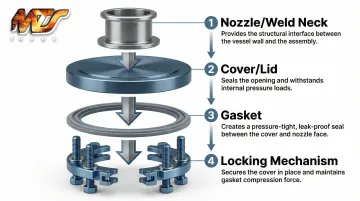
A complete manway assembly consists of four primary elements:
- Nozzle/weld neck: The cylindrical extension welded to the vessel wall, providing structural reinforcement
- Cover or lid: The door that seals the opening, engineered to withstand operating pressure
- Gasket: The sealing element between the cover and nozzle face, matched to fluid type and temperature
- Locking mechanism: Swing bolts, clamp rings, hinges, or handwheels that secure the cover and maintain seal integrity
Engineering Requirements
Manways are purpose-engineered components, not simply holes cut into a vessel. They must be designed to match the operating pressure, temperature, and fluid chemistry of the vessel. According to ASME BPVC Section VIII, Division 1 (UG-46), pressure vessels subject to internal corrosion require inspection openings with specific minimum dimensions: circular manholes must have at least a 16-inch inside diameter, while elliptical manholes require a minimum 12 × 16 inch opening.
Those code minimums set the floor—practical sizing goes further. Openings designed only for tool or equipment access typically start around 12 inches in diameter, while personnel entry requires 24 inches or more to allow safe passage during internal inspection or repair.
For critical high-pressure applications—particularly in power generation, defense, and nuclear sectors—manways often require forged steel construction rather than fabricated or cast components. Forged components offer superior grain structure and mechanical strength, which is why manufacturers like MTS Forge produce custom-forged manways specifically for these demanding environments. The forging process ensures dimensional consistency and material integrity that cast or fabricated alternatives can't reliably match.
What Is a Manway Used For?
The primary purpose of a manway is to provide safe, controlled access to the interior of a closed vessel without draining, dismantling, or permanently opening the container. Without manways, routine maintenance would require physically cutting into the vessel — an approach that is expensive, slow, and introduces serious safety risks.
Inspection Access
Technicians enter or look through manways to visually examine the interior for:
- Corrosion, cracks, or scaling on vessel walls
- Debris buildup or sediment accumulation
- Damage to internal components (liners, coatings, agitators, heating elements)
- Weld joint integrity at nozzles and attachment points
Regular internal inspections are often mandatory. API Standard 653 requires formal internal inspections of aboveground storage tanks at intervals determined by corrosion rates—not exceeding 20 years without effective corrosion protection, or 10 years otherwise. External visual inspections are required at least every 5 years.
Cleaning and Sanitation
In food, beverage, pharmaceutical, and chemical processing, manways allow workers or CIP (Clean-in-Place) equipment to sanitize vessel interiors. EHEDG guidelines state that if CIP is not employed, all equipment parts must be readily accessible for inspection, cleaning, and disinfection without tools.
Product-contact surfaces must meet strict hygiene standards — typically a surface roughness of Ra ≤ 0.8 µm (32 µin) per 3-A Sanitary Standards — to prevent bacterial harboring and maintain regulatory compliance.
Maintenance and Repair
Manways enable technicians to:
- Replace internal components (spray balls, baffles, sensors)
- Repair liners, coatings, or protective finishes
- Remove blockages or buildup
- Service internal mechanisms (agitators, mixers, heating/cooling coils)
In many cases, equipment too large to fit through other vessel openings (pumps, agitators, spray nozzles) must be inserted or removed through the manway.
Loading, Unloading, and Process Intervention
In brewing, food processing, and chemical manufacturing, manways are used to:
- Add ingredients or raw materials directly
- Insert hoses for product transfer
- Take samples from the vessel interior during production
- Provide pressure relief in over-pressurized scenarios (certain designs)
Types of Manways
Manway design is driven by vessel geometry, operating pressure, and access requirements. Shape and mounting orientation are the two primary variables that determine which type is right for a given application.
Round Manways
Round manways are the most common type, especially in pressurized vessels. The circular geometry distributes stress evenly around the sealing perimeter, making them highly effective at maintaining leak-proof seals under pressure.
Typical applications:
- Chemical processing tanks
- Brewing fermenters
- General industrial storage vessels
- Any high-pressure or vacuum application
Oval and Elliptical Manways
Oval or elliptical manways are frequently mounted on vessel sides. They offer a larger opening footprint that makes personnel entry easier while keeping the cutout in the vessel wall as small as possible.
According to manufacturer specifications, oval manways are self-sealing under positive internal pressure—a key advantage for side-mounted installations below the liquid level. This self-sealing behavior extends to vacuum conditions as well, which is why oval designs are common in sanitary and food-grade settings.
Rectangular Manways
Rectangular manways are typically used in lower-pressure or atmospheric applications, such as utility storage tanks or large process vessels, where the priority is maximum access width.
The pressure limitation comes down to geometry: flat corners create stress concentration points that are harder to seal reliably. Engineering analysis shows rectangular holes with corners experience higher stress concentration factors (Kt) at the corners, requiring specific calculations to manage stress distribution.
Mounting Orientation: Top vs. Side
Beyond shape, manways are categorized by installation location:
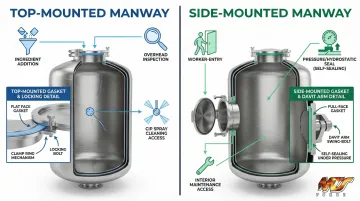
- Top-mounted manways: Used for ingredient addition, overhead inspection, or spray cleaning access
- Side-mounted manways: Allow worker entry without overhead access equipment; popular for maintenance tasks requiring full interior access
The orientation affects the required locking mechanism and gasket design. Side-mounted manways below the liquid level must resist hydrostatic pressure and are often self-sealing designs.
Manway vs. Manhole: Key Differences
The terms "manway" and "manhole" are often used interchangeably, but there are meaningful distinctions in industrial contexts.
Industrial vs. Municipal Terminology
In process vessel engineering, "manway" specifically refers to an engineered access point on a pressure vessel or process tank—designed and rated for the operating conditions of that vessel.
"Manhole" is a broader term historically associated with utility infrastructure access—sewers, underground vaults, utility corridors. In municipal applications, manholes provide entry points for workers to access underground systems for inspections and repairs.
Functional Distinctions
Industrial manways are pressure-rated components built for demanding operating conditions:
- Engineered gaskets and tested sealing mechanisms rated for specific PSI
- Compliance with vessel codes (ASME BPVC Section VIII)
- Weld necks, yoke-and-bolt, or T-bolt closures
- Application-specific materials and coatings
Non-pressure manholes are a different category entirely:
- Simpler covers not designed to hold internal pressure or vacuum
- Often gravity-seated, which can allow water infiltration if improperly seated
- Used on open-top tanks or atmospheric storage vessels
That distinction matters in practice. In food, beverage, and brewing applications, operators use both terms side by side specifically to flag which type of opening they're working with—pressure-rated or not—before any maintenance begins.
Manway Materials and How to Choose the Right One
Material selection is driven by three primary factors: chemical compatibility of the fluid inside the vessel, operating pressure and temperature, and hygiene or regulatory requirements of the industry.
Stainless Steel: The Industry Standard
316L stainless steel is the most widely used material for manways. It contains 16% chromium, 12% nickel, and 2% molybdenum, providing superior resistance to pitting and crevice corrosion in chloride environments compared to 304 stainless.
304/304L stainless steel is the classic 18Cr-8Ni composition, suitable for general corrosion resistance in less aggressive environments.
Specialty Alloys for Severe Environments
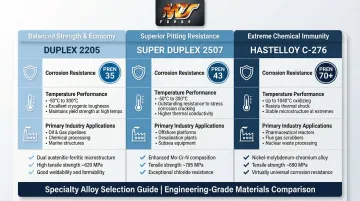
For highly corrosive or extreme-temperature applications, advanced materials are required:
| Material | Key Characteristics | Applications |
|---|---|---|
| Duplex 2205 | Austenitic-ferritic structure; yield strength roughly twice that of austenitic stainless; resistant to chloride stress corrosion cracking | Offshore platforms, chemical processing |
| Super Duplex 2507 | PREN of 42 (vs. 35 for 2205, 24 for 316L); exceptional chloride resistance | Seawater applications, aggressive chemical environments |
| Hastelloy C-276 | Nickel-chromium-molybdenum alloy; strong resistance to hot contaminated mineral acids and wet chlorine gas | Chemical processing, waste treatment |
Surface Finish for Sanitary Applications
For food, beverage, and pharmaceutical applications, surface finish is critical. Internal surfaces must meet Ra ≤ 0.8 µm (32 µin) per 3-A Sanitary Standards to prevent bacterial harboring.
Gasket Material Compatibility
Gasket material must be matched to fluid type, temperature, and cleaning chemistry:
| Gasket Material | Temp Range | Best For | Limitations |
|---|---|---|---|
| EPDM | -50°C to 150°C | Hot water, steam, alkaline solutions | Not resistant to oils, greases, fuels |
| FKM (Viton) | -25°C to 200°C | Mineral oils, fuels, hydrocarbons | Degraded by polar solvents, ketones |
| Silicone (VMQ) | -55°C to 200°C | Dry heat applications | Poor oil/gasoline/acid resistance |
| ePTFE | -60°C to 230°C | Chemically inert to pH 0-14 (except molten alkali metals) | Higher cost |
Forged Steel for Critical Applications
For power generation, nuclear, chemical processing, defense, and aerospace applications, manways on pressure vessels require forged steel construction rather than fabricated or cast components.
Forging refines grain structure and develops optimum grain flow, yielding 37% higher fatigue strength and 26% higher tensile strength compared to cast parts. Forgings are also free from the internal voids, dendritic structures, and alloy segregation that castings cannot fully avoid.
MTS Forge has produced custom-forged manway components since 1986, covering materials from 304/304L and 316L stainless to Hastelloy C-276 and Duplex 2205. For nuclear and safety-critical applications, the company holds certifications including Mil I 45208, NCA 3800, and Mil Q9858.
Industries That Rely on Manways
Food, Beverage, and Pharmaceutical
These industries rely on sanitary stainless steel manways for CIP cleaning, inspection, and ingredient loading across fermenters, mixing tanks, and process vessels. Every aspect of the assembly must meet strict hygienic design requirements per 3-A Sanitary Standards, covering:
- Surface finish specifications
- Gasket material compatibility
- Drainage design to prevent bacterial growth
Oil, Gas, Chemical, and Fuel Storage
Manways are critical on storage tanks, tanker trailers, and process vessels for:
- Loading/unloading operations
- Internal inspection for corrosion or contamination
- Maintenance and component replacement
At gas stations, a "manway" refers to the access opening on the underground storage tank (UST)—typically a bolted cover at or near ground level. Per EPA regulations (40 CFR 280.70), when a UST system is temporarily closed for 3 months or more, owners must cap and secure all lines, pumps, manways, and ancillary equipment.
Power Generation, Defense, Nuclear, and Heavy Industrial
Pressure vessels in these industries—boilers, heat exchangers, reactors, and storage vessels—use heavy-duty manways that must meet stringent codes:
- ASME BPVC Section VIII for pressure vessels
- ASME BPVC Section III (Subsection NCA) for nuclear facility components (Classes 1, 2, 3)
- API Standard 650 for welded tanks for oil storage
- EU PED (2014/68/EU) for pressure equipment in European applications
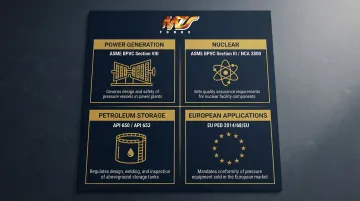
Extreme pressures and temperatures in these environments require forged steel manway components rather than cast or fabricated alternatives.
MTS Forge manufactures forged manway components for nuclear and defense applications, holding NCA 3800 certification and Mil-spec compliance (Mil I 45208, Mil Q9858).
Frequently Asked Questions
What is a manway?
A manway is a reinforced access opening built into a tank or pressure vessel, large enough to allow a person or equipment to enter. It provides safe access for inspection, cleaning, and maintenance without dismantling the vessel.
What is a manway used for?
Common uses include:
- Internal inspection for corrosion or damage
- Cleaning, including CIP (clean-in-place) systems
- Maintenance and repair of internal components
- Ingredient loading and equipment insertion or removal
Manways enable routine vessel servicing without draining or cutting into the container.
What is the difference between a manhole and a manway?
A manway is an engineered, pressure-rated access port on a process vessel, designed to withstand specific operating pressures and temperatures with tested sealing mechanisms. A manhole typically refers to utility infrastructure access points (sewers, underground vaults) or non-pressure-rated openings on atmospheric tanks.
What is a manway at a gas station?
At a gas station, a manway is the bolted access cover on the underground storage tank (UST), located at or near ground level. Technicians use it for fuel delivery, pump installation, inspection, and compliance testing. EPA regulations require these openings to be secured during tank closures.
What materials are manways typically made from?
Stainless steel grades 304/304L and 316L are standard for sanitary and corrosion-resistant applications. Carbon steel is used for general industrial applications. Specialty alloys (Duplex 2205/2507, Hastelloy C-276) or forged steel are required for high-pressure, high-temperature, or safety-critical environments like power generation and defense.
What standards govern manway design and installation?
ASME BPVC Section VIII (particularly Division 1 for pressure vessels) governs manway design in the U.S. for pressurized applications. Industry-specific standards include 3-A Sanitary Standards for food/beverage, API 650/653 for petroleum storage, and ASME Section III (NCA 3800) for nuclear applications.