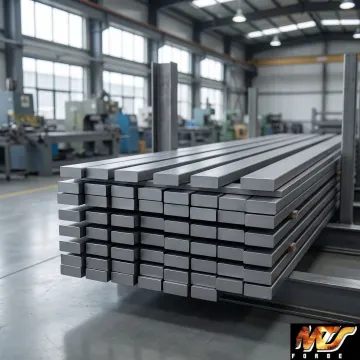
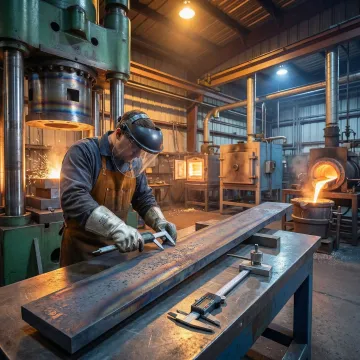
Normalized 4140 refers to AISI 4140 alloy steel — a chromium-molybdenum grade — that has been subjected to the normalizing heat treatment process. The steel is heated above its upper critical temperature (typically around 1600–1700°F) and then cooled in still air at room temperature. This process refines the grain structure created during hot working or forging, producing a uniform, fine-grained microstructure with consistent tensile strength, improved toughness, and better machinability compared to the as-forged or as-rolled condition. Normalized 4140 flat bars are widely used in aerospace, defense, and power generation components.
What alloy steel grades are available as normalized flat bars?
MTS Forge works across a broad range of alloy steel grades for normalized flat bar production. Common grades include 4140, 4340, 8620, and other chromium-molybdenum and nickel-chromium-molybdenum steels. We also work with stainless and high-performance alloys depending on application requirements. Contact our team to confirm availability for your specific grade and specification.
Why is normalizing preferred over annealing for forged flat bars?
Normalizing is the most commonly specified heat treatment for hot forgings because it is performed in still air rather than a controlled furnace cool, making it faster and more cost-effective than full annealing. It produces a finer, more uniform grain structure than annealing while delivering adequate ductility and superior machinability for most industrial applications. For forged components, normalizing effectively eliminates the uneven grain growth and internal stresses introduced during the forging process.
What mechanical properties can I expect from normalized alloy steel flat bars?
Normalized alloy steel flat bars exhibit improved tensile strength, enhanced toughness and ductility, relieved internal stresses, and better machinability compared to as-forged material. The exact mechanical property values depend on the alloy grade, section size, and chemistry. MTS Forge provides full material certifications with each shipment, including mechanical test data where required by your specification.
Is the normalizing heat treatment performed in-house at MTS Forge?
Yes. MTS Forge performs normalizing heat treatment entirely in-house at our Coatesville, Pennsylvania facility. This eliminates reliance on third-party heat treaters, reduces lead times, and gives us complete control over the process parameters — ensuring every normalized alloy steel flat bar meets the required microstructural and mechanical property standards before shipment.
What quality certifications apply to your normalized alloy steel flat bars?
MTS Forge operates under a comprehensive Quality Assurance Program that includes Mil I 45208, NCA 3800, and Mil Q9858 certifications. These standards govern inspection, traceability, and process control throughout production. Full material traceability from mill source to finished component is maintained for every order, supporting the compliance requirements of aerospace, defense, commercial nuclear, and power generation customers.
What industries use normalized alloy steel flat bars?
Normalized alloy steel flat bars are used across a wide range of industries where structural reliability and consistent mechanical properties are critical. MTS Forge supplies these products to customers in aerospace, defense, power generation, commercial nuclear, chemical processing, machine manufacturing, oil and gas, and construction sectors — wherever components must withstand mechanical stress, fatigue, or elevated-temperature service conditions.
Can MTS Forge provide normalized flat bars cut to custom lengths or near-net shapes?
Yes. MTS Forge offers in-house sawing up to 16 inches OD and rough machining services that can bring normalized alloy steel flat bars to near-net dimensions following heat treatment. This reduces your downstream processing requirements and total supply chain cost. Custom lengths, profiles, and dimensional requirements can be accommodated — contact our team to discuss your specific needs.